
Automatic Kitchen Hood Suppression System for Commercial Kitchens
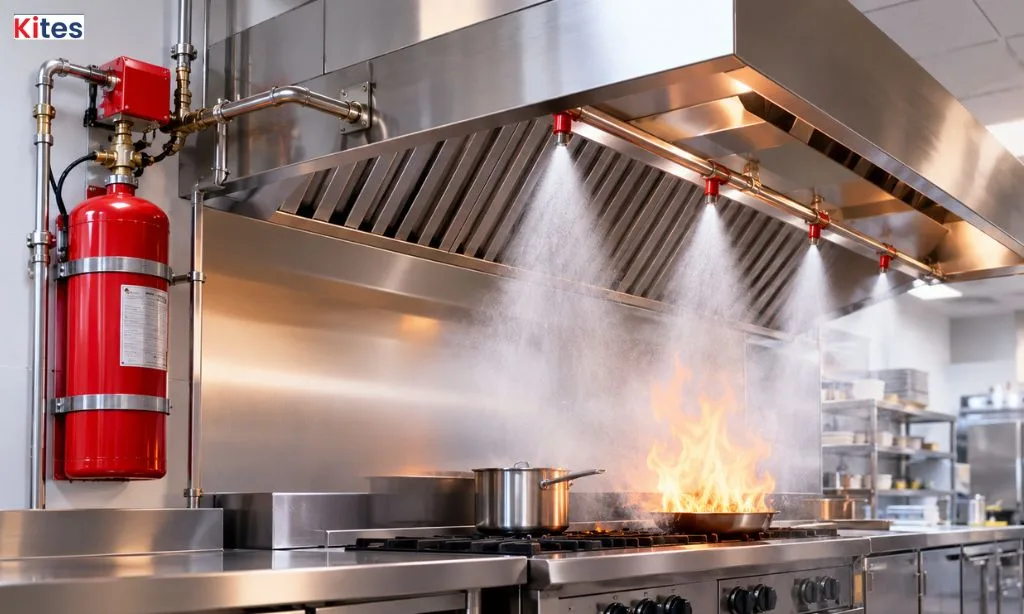
An automatic kitchen hood suppression system is a fixed fire protection unit installed inside and above a commercial kitchen's exhaust hood. It detects cooking-related fires through heat sensors and automatically discharges a wet chemical agent onto the fryers, griddles, ranges and hood plenum while cutting fuel or power to the cooking equipment — no manual trigger needed.
Commercial kitchens run high-temperature, grease-heavy equipment for hours at a stretch — exactly the fire risk profile a standard sprinkler system cannot handle. Water on a grease fire spreads it; a wet chemical agent is engineered specifically for cooking-oil and grease fires and discharges the moment heat sensors detect a fire.
Kitessafety Advanced Fire & Safety Company designs, supplies, installs, tests and maintains automatic kitchen fire suppression systems for restaurants, hotel kitchens, cloud kitchens and industrial catering facilities across Saudi Arabia, with service coverage across Dammam, Khobar, Dhahran, Jubail, Riyadh, Jeddah and commercial kitchens Kingdom-wide.
What Is an Automatic Kitchen Hood Suppression System?
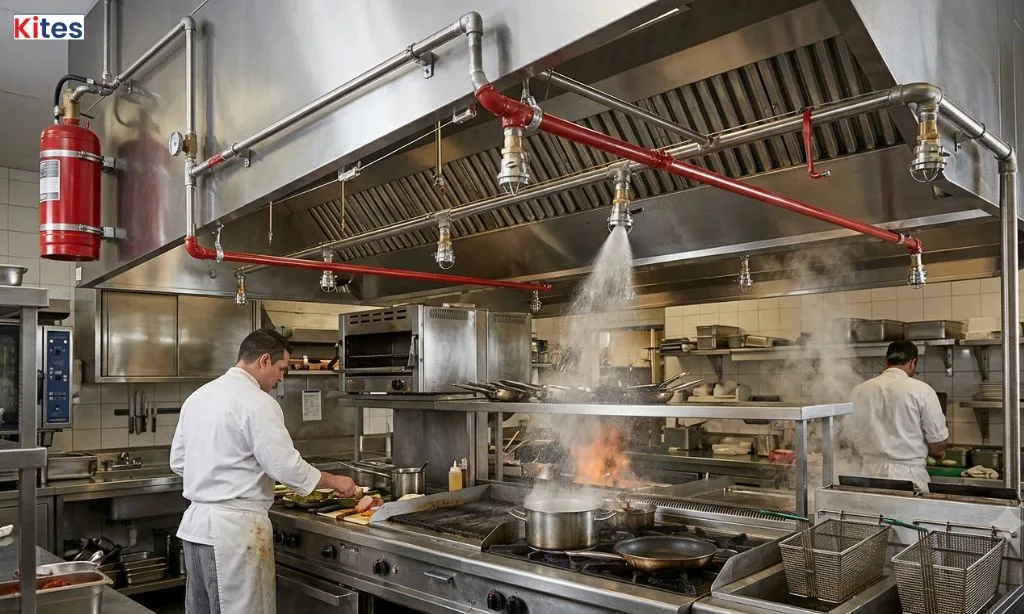
This type of automatic kitchen hood fire suppression setup is a self-contained fire protection system built around a pressurised cylinder of wet chemical agent, connected through pipework to discharge nozzles positioned over each cooking appliance and inside the exhaust hood and duct. Heat detectors mounted above the cooking line trigger the system once temperatures cross a fire-risk threshold — without requiring anyone to pull a manual station first, although a manual pull station is also included as a backup.
How Does It Work?
The system follows the same five-stage sequence on every activation, whether triggered automatically by heat or manually by a staff member:
Heat Detection
Fusible-link or electronic heat detectors positioned above each appliance sense abnormal heat from a fire.
Automatic System Activation
Once the detection threshold is reached, the mechanical or electrical control mechanism releases the suppression agent cylinder without any manual step.
Wet Chemical Discharge
The agent travels through distribution pipework to nozzles aimed at each fryer, griddle, range and the hood plenum, cooling the fire and forming a soap-like layer over hot oil to prevent re-ignition.
Fuel or Power Shutdown
The same activation signal simultaneously cuts the gas or electrical supply to the cooking line, removing the heat source feeding the fire.
Fire Control and System Reset
After the fire is knocked down, the system requires a professional inspection, cylinder recharge and mechanical reset before returning to a ready state.
What Does the System Protect?
- Cooking appliances directly under the hood — fryers, griddles, char-broilers, ranges and woks
- The hood plenum, the enclosed space directly above the cooking line where grease vapour collects
- The exhaust duct running from the hood to the roof, one of the most common places a grease fire spreads unnoticed
- The area immediately in front of the appliances, protecting staff working the line when the system activates
Why Choose Kites Safety for Automatic Kitchen Hood Suppression?
Kites Advanced Fire & Safety Company has over 10 years of experience across Saudi Arabia's fire suppression sector, working with 12 client organisations across 8 service lines covering the full lifecycle of a kitchen suppression system: design and engineering, supply and installation, testing and commissioning, inspection, refilling and recharge, preventive maintenance, annual maintenance contracts, and emergency service support. Rather than a one-time installation, Kites stays engaged through the system's ongoing testing and recharge cycle — the part of fire suppression ownership most commercial kitchens underestimate until an inspection is overdue.
Key Components of the System
| Component | Function |
|---|---|
| Wet Chemical Cylinder | Pressurised tank storing the fire suppression agent, sized to the kitchen's cooking line length |
| Distribution Pipework | Stainless steel pipes routing the agent from the cylinder to each discharge point |
| Discharge Nozzles | Positioned above each cooking appliance and inside the hood plenum for targeted coverage |
| Heat Detectors | Fusible-link or electronic sensors that trigger automatic activation when fire temperatures are detected |
| Manual Pull Station | Wall-mounted backup trigger allowing staff to activate the system manually in an emergency |
| Gas/Electrical Shut-off | Integrated mechanism that cuts fuel or power to the cooking line the moment the system activates |
| Control Head / Actuator | Mechanical or electrical mechanism that releases the cylinder's contents on activation |
Automatic vs Manual Kitchen Hood Fire Suppression
Every automatic system also includes a manual pull station, but the two activation paths behave differently in a real fire:
| Feature | Automatic Activation | Manual Activation |
|---|---|---|
| Trigger | Heat detectors sense fire temperatures automatically | Staff member pulls the manual station |
| Response Time | Immediate once threshold is reached — no human delay | Depends on staff noticing the fire and reaching the station |
| After-Hours Coverage | Active 24/7, even when the kitchen is unoccupied | Requires someone physically present to activate |
| Fuel/Power Cut-off | Triggered simultaneously with agent discharge | Same — manual pull triggers the same shut-off sequence |
| Reliability | Not affected by staff training gaps or panic | Depends on staff awareness and physical access to the station |
Why Commercial Kitchens Need Automatic Fire Suppression
Commercial cooking equipment operates at temperatures and durations that residential kitchens never reach, and grease that accumulates in a hood and duct over weeks of service is exactly the fuel a fire needs to spread beyond the cooking line. Fire protection design for commercial kitchen exhaust systems is governed internationally by standards such as NFPA 96, which covers ventilation control and fire protection of commercial cooking operations. A kitchen operating without automatic suppression depends entirely on staff noticing a fire in time — in an environment where grease fires can spread through a duct in under a minute.
Suppression Needs Across Different Commercial Kitchens
| Kitchen Type | Primary Risk | Suppression Considerations |
|---|---|---|
| Restaurant Kitchens | Deep fryers and open-flame grills producing heavy grease vapour | Nozzle coverage per appliance zone, multiple hood sections |
| Hotel & Banquet Kitchens | Long cooking lines with extended hood runs | Larger cylinder capacity, multiple zones, phased maintenance schedules |
| Cloud / Ghost Kitchens | Multiple brands sharing compact cooking space | Dense nozzle placement, shorter duct runs, rapid-response detection |
| Industrial Catering | High-volume cooking for extended hours | Heavy-duty cylinders, frequent recharge intervals, AMC coverage |
| Fast Food Chains | Continuous fryer operation across peak hours | Dedicated fryer-zone nozzles, standardised system design across outlets |
Installation Process
A kitchen hood suppression system installation begins with a site assessment of the hood layout, appliance positions and duct run, since nozzle placement must match the exact cooking equipment underneath — not a generic template. Kites' design and engineering team maps out cylinder location, pipe runs and nozzle coverage before installation starts, followed by supply and installation of the physical system, and testing and commissioning to confirm the system activates and discharges correctly before the kitchen goes live.
Ongoing Maintenance
Kitchen fire suppression system maintenance is not optional once a system is installed. Grease accumulation, nozzle blockage and a discharged or expired cylinder all reduce a system's ability to activate correctly. Kites' preventive maintenance and annual maintenance contracts cover scheduled inspection, while refilling and recharge replaces the suppression agent after any activation or once a cylinder reaches its service interval — keeping the system permanently ready.
Our Installation and Maintenance Process
- Site assessment of the kitchen layout, hood, duct run and appliance positions
- System design mapping cylinder placement, pipe runs and nozzle coverage to the actual equipment
- Supply and installation of the suppression system, detection, pipework and shut-off integration
- Testing and commissioning to confirm correct activation before handover
- Ongoing inspection, preventive maintenance and refilling under a maintenance contract
What Happens After the System Activates?
A system that has discharged is not automatically ready to protect the kitchen again. After any activation, gas or power to the cooking line stays cut off until a qualified technician inspects the system, cleans residual wet chemical agent from the hood and appliances, and confirms the fire is fully out. The discharged cylinder then needs professional refilling and recharge, and the detection and control mechanism needs a mechanical reset before the kitchen can resume cooking. Running a kitchen on a system that discharged but was never serviced leaves it with no suppression at all — even though the hood is still physically in place.
Protect Your Commercial Kitchen With an Automatic Suppression System
A commercial kitchen hood suppression system protects your highest-risk equipment without depending on staff noticing a fire in time — and it stays reliable only with regular inspection, maintenance and prompt recharge after any activation. Kites Advanced Fire & Safety Company covers the full lifecycle across Saudi Arabia, from initial design through years of ongoing maintenance.
Request a Kitchen Safety Assessment
Frequently Asked Questions
What is an automatic kitchen hood suppression system?
How does a kitchen hood suppression system detect a fire?
Is a kitchen hood suppression system required by law in Saudi Arabia?
What is the difference between a wet chemical and a dry chemical kitchen suppression system?
How often should a kitchen hood suppression system be inspected?
Can a kitchen keep operating after the suppression system activates?
What areas does the system cover?
How much does an automatic kitchen hood suppression system cost?
Which areas in Saudi Arabia does Kites Safety cover for kitchen hood suppression?
About Kites Advanced Fire & Safety Company
Kites Advanced Fire & Safety Company is a Dammam-based fire and life safety company with over 10 years of experience, offering design, installation, testing, inspection, refilling and maintenance services for fire suppression systems across Saudi Arabia.
Reviewed By
L K Monu Borkala is a digital marketing strategist with 20+ years of SEO experience and over 650 client campaigns across India and UAE. As a founding member of OneCity Technologies, Bangalore, he oversees content strategy and editorial compliance across industrial, safety and business services verticals.