
Cloud Kitchen Fire Suppression System in Saudi Arabia
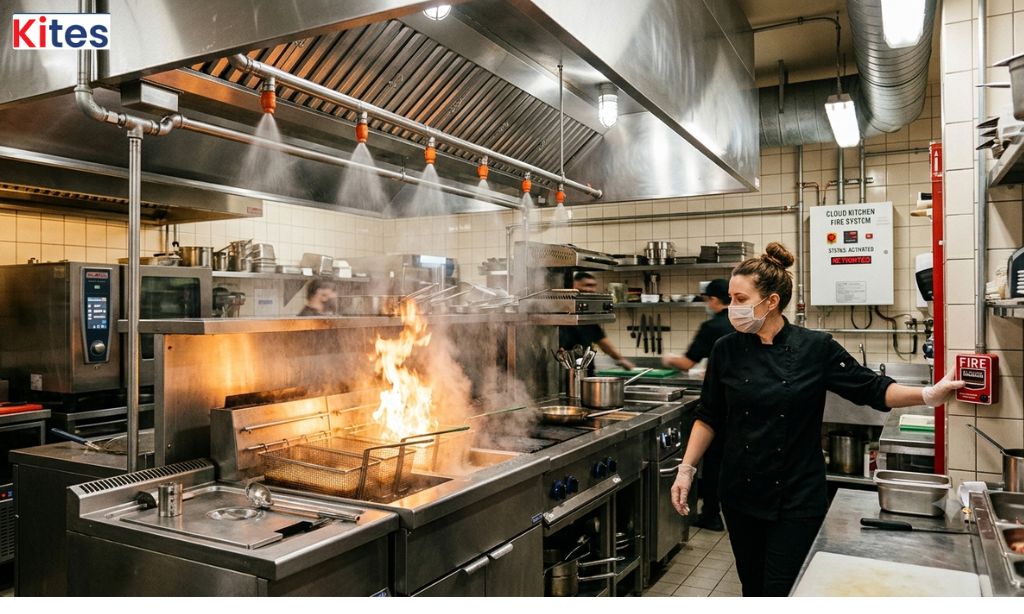
A cloud kitchen fire suppression system is a fixed, automatic wet chemical system installed over the cooking line and inside the exhaust hood and duct of a delivery-only kitchen. Heat sensors trigger it without staff input: it discharges agent onto fryers, griddles and ranges, then shuts off gas or power to the equipment.
A cloud kitchen, sometimes called a ghost or dark kitchen, prepares food only for delivery and pickup. There is no dining room, so almost every square metre goes to cooking, and many units run several food brands from one hood line. That packs fryers, griddles and charbroilers into a small footprint, often working late into the night with a thin crew.
Kites Safety's own industries page makes the point plainly: a cloud kitchen has the same appliances, the same grease loading and the same exhaust hazard as a restaurant kitchen. The difference is how little space it all shares. Grease builds up in the hood and duct, and a fire that starts at an appliance can travel upward before anyone sees it.
Portable fire extinguishers alone do not close that gap. An extinguisher needs a trained person within reach, and a fire that has already entered the duct is beyond its reach. A dedicated suppression system detects the heat, discharges the agent and cuts the fuel automatically.
Kites Advanced Fire & Safety Company designs, supplies, installs, tests and maintains the Cloud Kitchen Fire Suppression System in Saudi Arabia, with coverage across Dammam, Khobar, Dhahran, Jubail, Riyadh, Jeddah and cloud kitchens Kingdom-wide. The rest of this page covers how the system works, what it protects, how it differs from extinguishers, and what installation and upkeep involve.
Talk to Kites Advanced Fire & Safety Company in Ad Dammam: call +966 592 066 358 or email enquiry@kitessafety.com.
What Is a Cloud Kitchen Fire Suppression System?
It is the fixed protection built into the cooking line itself: a pressurised cylinder of wet chemical agent, pipework, discharge nozzles aimed at each appliance, heat detectors above them, and a release mechanism that fires the cylinder when the detectors trip. A gas or electrical shut-off is wired to the same release, so the heat source is removed at the moment the agent goes on.
The equipment is the same family as the Commercial Kitchen Fire Suppression System fitted in restaurants and hotels. What changes is the layout it must fit: tighter hood runs, more appliances per metre, and cooking lines that get rearranged when a brand is added or dropped. Kites covers the wider category on its main kitchen fire suppression systems page; this page deals with what is specific to delivery-only kitchens.
Operators sometimes call it a Cloud Kitchen Fire Safety System or a Cloud Kitchen Fire Protection System. The names differ and the equipment does not. A fire alarm, sprinklers and a cabinet of extinguishers all belong in the overall fire safety plan, but the suppression system is the only part aimed directly at the cooking fire.
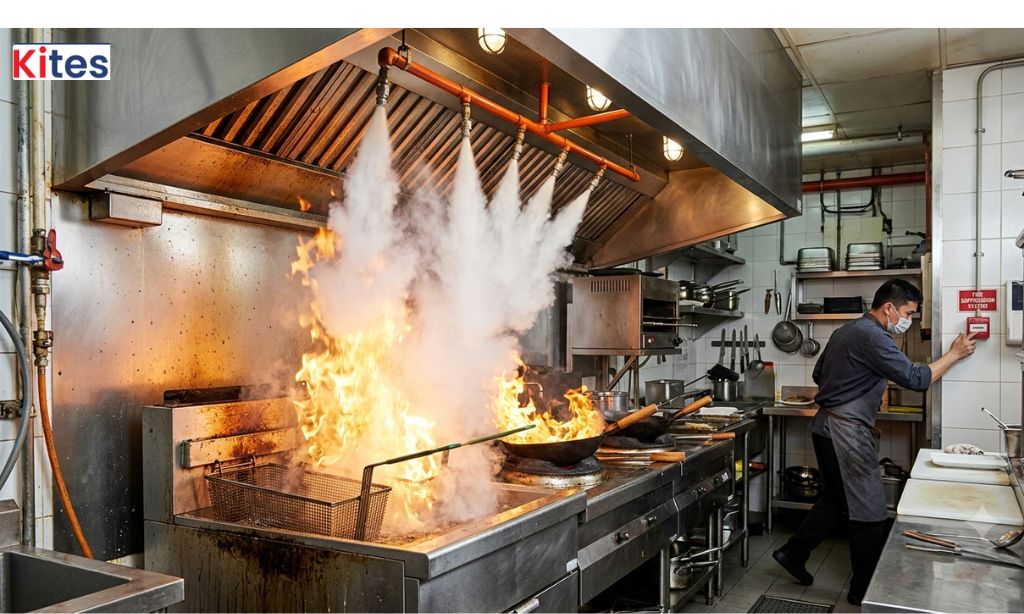
Shared hoods deserve a closer look. One brand's fryer oil becomes another brand's hood grease, and when nobody clearly owns the duct, cleaning and inspection dates slip. A suppression system with its own maintenance contract gives a shared kitchen a fixed point of accountability that a verbal agreement between tenants does not.
Rules and expectations also stack up from several directions. Saudi Civil Defense and the Saudi Building Code set fire protection requirements, while landlords and insurers may also ask to see proof of an installed and serviced system before a cooking unit opens. Internationally, NFPA 96 is the reference standard for ventilation control and fire protection of commercial cooking operations. Requirements vary by premises, so confirm yours with Civil Defense and your insurer before fit-out begins.
Protect Your Kitchen
Protect Your KitchenHow Does a Cloud Kitchen Fire Suppression System Work?
An Automatic Fire Suppression System for Cloud Kitchens runs the same five-stage sequence every time, whether the trigger is heat or a staff member pulling the manual station.
1. Heat Detection
Fusible links or electronic detectors sit above each appliance and in the hood. When temperature climbs past the fire threshold, they react. Nobody has to notice smoke first, which matters at 3 a.m. when one cook is plating orders at the far end of the line.
2. Automatic Activation
The detector releases the mechanism that opens the agent cylinder. No manual step is needed. A pull station near the exit is still fitted as a backup, so a person who sees flames first can start the system by hand.
3. Wet Chemical Discharge
Agent travels through the pipework to nozzles aimed at specific appliances, the hood plenum and the duct. It cools the burning oil and forms a soapy layer on the surface that stops it from re-igniting. Nozzles already aimed at the oil, the hood and the duct do the work, and nobody has to carry anything across the kitchen.
4. Gas and Power Shutdown
The same release cuts gas or electrical supply to the cooking equipment. This step is easy to overlook, yet it is what stops a fryer from continuing to heat oil that was just extinguished.
5. Fire Control and Reset
Once the fire is out, the system is spent. A qualified technician must inspect the kitchen, clean residual agent, recharge the cylinder and reset the mechanism before cooking resumes. A discharged system left unrecharged protects nothing.
What Does a Cloud Kitchen Fire Suppression System Protect?
Coverage is designed appliance by appliance and zone by zone. Kites groups what it protects into four categories, listed on its equipment page.
| Category | Typical Items | Why It Needs Coverage |
|---|---|---|
| Cooking equipment | Deep fat fryers, griddles, cooking ranges, woks, ovens, salamanders | Hot oil and grease sit directly under the hood |
| Open-flame appliances | Charbroilers, lava rock grills, rotisserie equipment, BBQ stations | Live flame can ignite grease that drips or flares |
| Exhaust protection areas | Hood, plenum, duct and filters | Grease collects here and carries a fire upward |
| Auxiliary systems | Gas shut-off, electrical shutdown, alarm interface | Remove the fuel and alert the building |
Layout is the catch. Nozzles are aimed at the appliances that existed when the system was designed. Kites' equipment page gives a blunt example: a fryer replaced with a larger model, or a griddle moved half a metre to make room for prep space, can leave equipment outside the designed coverage. In a cloud kitchen, where lines are reshuffled for each new brand, that scenario is routine rather than rare.
Key Components of a Cloud Kitchen Fire Suppression System
| Component | What It Does | Cloud Kitchen Consideration |
|---|---|---|
| Agent cylinder | Stores pressurised wet chemical agent until release | Sized to the total appliance load under the shared hood |
| Heat detectors | Fusible links or electronic sensors that sense fire temperature | Positioned for every appliance, including late additions |
| Discharge nozzles | Direct agent onto each appliance, hood and duct | Re-aimed when equipment is replaced or moved |
| Distribution pipework | Carries agent from cylinder to nozzles at the right pressure | Routed around tight hood runs and compact ceilings |
| Manual pull station | Lets staff trigger the system by hand | Placed on the exit path from the cooking line |
| Release mechanism | Opens the cylinder when detectors or the pull station trip | Checked on every maintenance visit |
| Gas and electrical shut-off | Cuts fuel or power to the cooking equipment | Must cover every energy source feeding the line |
| Alarm interface | Links the system to the building fire alarm panel | Important where the unit sits inside a larger commercial building |
Wet Chemical Fire Suppression for Cloud Kitchens
A Wet Chemical Fire Suppression System for Cloud Kitchens uses a liquid agent designed for cooking oil and animal fat fires. Applied to burning oil, the agent reacts with the hot fat to form a soapy foam. That foam cools the oil and seals the surface from oxygen, which is what prevents the flare-up from returning once the flames are knocked down.
Water is the wrong tool. It sinks below burning oil, flashes to steam and throws burning grease outward. Dry chemical agents can put out a flame but leave the oil hot enough to re-ignite. Wet chemical agent addresses both problems, which is why it is the usual choice for commercial cooking equipment.
Ask any supplier which test standard the system was listed against. UL 300 is the fire test standard for extinguishing systems protecting commercial cooking equipment, and a listing document is the evidence to request. In practice this protection takes the form of a Kitchen Hood Fire Suppression System, and Kites explains that hood-level design on its kitchen hood fire suppression page. The chemistry and sequence are covered in more depth in Kites' article on how wet chemical fire protection works in commercial kitchens.
Cloud Kitchen Fire Suppression System vs Fire Extinguishers
Both belong in a cloud kitchen, but they do different jobs. The suppression system is built to stop a cooking fire on its own; the extinguisher is a backup for a person standing nearby.
| Factor | Fixed Suppression System | Portable Extinguisher |
|---|---|---|
| Activation | Automatic through heat detection, with manual backup | A person must grab it, pull the pin and aim |
| Works when nobody is at the cooking line | Yes | No |
| Reaches fire inside hood and duct | Yes, through dedicated nozzles | No |
| Cuts gas or power to the equipment | Yes, from the same release | No |
| Training required to use it | None to trigger; staff only need to know the pull station | Staff must be trained and nearby |
| Best role | Primary protection for the cooking line | Backup for small fires caught early |
Portable extinguishers rated for cooking oil fires (Class K) are standard practice beside a cooking line. Treat them as a second layer. One cook working alone at night cannot fight a duct fire with a hand-held cylinder, and the extinguisher cannot shut off the gas that is feeding it.
Cloud Kitchen Fire Suppression System Installation Process
Installation is a sequence of site decisions. Each step feeds the next, and skipping the survey is the most expensive shortcut.
- Site survey: hood dimensions, duct run, appliance positions, gas and electrical isolation points, and the list of brands sharing the line
- System design: cylinder sizing, pipe routing, nozzle aiming for each appliance, and detector placement
- Supply: agent cylinders, pipework, nozzles and shut-off hardware matched to the design
- Installation: fitting works scheduled around the kitchen fit-out and coordinated with the gas and electrical contractors
- Integration: connecting the alarm interface and confirming the shut-off covers every energy source on the line
- Handover: documentation for the landlord, insurer and Civil Defense file
The design and fitting stages are where errors creep in. Kites has also written up five common installation mistakes that are worth reading before the site survey
Testing and Commissioning of Cloud Kitchen Fire Suppression Systems
A system is not finished when the last nozzle is fitted. Commissioning proves that the installed system does what the design says, against the kitchen as it actually stands on opening day.
| Commissioning Check | What Is Confirmed |
|---|---|
| Detector response | Heat detectors trip the release mechanism at the intended temperature |
| Release mechanism | Automatic and manual activation both open the cylinder |
| Nozzle coverage | Every appliance and the hood and duct sit inside a designed zone |
| Gas and power shut-off | Fuel and electrical supply cut on activation |
| Alarm interface | Signal reaches the building fire alarm panel |
| Documentation | Records complete for landlord, insurer and authorities |
Kites carries this out through its testing and commissioning service, and repeats the same verification during scheduled inspections. If the cooking line has changed since the last visit, the nozzle coverage check is the one that matters most.
Our Cloud Kitchen Fire Suppression System Process
Installation is only the first half of the job. After handover, the system moves onto a preventive maintenance schedule or an annual maintenance contract, with refilling and recharging after any discharge. Kites' article on the consequences of skipping maintenance explains why the schedule matters, and the kitchen suppression maintenance page lists what each visit covers.
For a cloud kitchen, add one trigger that a standard schedule does not include: a coverage review whenever the cooking line changes. Any of the following should prompt a call:
- A new brand is added to the kitchen
- A fryer or other appliance is replaced with a different size
- A griddle, range or grill is moved
- The hood, duct or filters are modified
- A gas or electrical supply line is relocated
Reviewing early costs far less than discovering at the moment of a fire that the nozzles are aimed at a gap where the fryer used to be.
Protect Your Cloud Kitchen With a Professionally Designed Fire Suppression System
A cloud kitchen concentrates cooking risk into a small footprint, and a fire there tends to be noticed late. A properly designed Cloud Kitchen Fire Protection System catches it automatically, smothers it and removes the fuel. It stays dependable only when it is inspected on schedule, recharged after any discharge and reviewed whenever the equipment changes. Kites Safety delivers that full cycle for the Cloud Kitchen Fire Suppression System in Saudi Arabia, from the first site survey through years of maintenance. For the wider picture, see Kites' automatic hood suppression page and its contractor overview.
- +966 592 066 358
- enquiry@kitessafety.com
- 4986 King Khalid – Ar Rabi, Unit No.6, Ad Dammam 32241-8167, Kingdom of Saudi Arabia
Request a quote
Fastest response: message us on WhatsApp or email enquiry@kitessafety.com.
Frequently Asked Questions
What is a cloud kitchen fire suppression system?
It is a fixed, automatic fire protection system fitted over the cooking line and inside the exhaust hood and duct of a cloud kitchen. Heat detectors trigger it, a wet chemical agent is discharged onto the cooking equipment, and gas or electrical supply to that equipment is cut at the same moment.
Do cloud kitchens need a fire suppression system in Saudi Arabia?
Any cloud kitchen cooking with fryers, griddles, ranges or charbroilers under an exhaust hood carries the same grease-fire risk as a restaurant. Requirements are applied through Saudi Civil Defense, the Saudi Building Code, your landlord and your insurer, so confirm the exact requirement for your premises before fit-out.
Is a fire extinguisher enough for a cloud kitchen?
No. A portable extinguisher needs a trained person standing close enough to use it, and it cannot reach a fire that has entered the hood or duct. It is a useful backup beside a fixed suppression system, not a replacement for one.
How does a wet chemical system work in a cloud kitchen?
Heat detectors above the cooking line trip the release mechanism, the cylinder discharges wet chemical agent through nozzles aimed at each appliance and the hood, and the agent cools the burning oil and forms a soapy layer that seals the surface. The same trigger shuts off gas or power to the equipment.
Can several brands in one cloud kitchen share a single suppression system?
Yes, provided the system is designed around the actual appliances under the shared hood, whichever brand uses them. Nozzle coverage follows the equipment layout, so every fryer, griddle and range operated by any brand has to sit inside a designed protection zone.
What happens to the system when a cloud kitchen changes its menu or equipment?
Coverage can fall out of date. A larger fryer, a relocated griddle or a new appliance added for a new brand may sit outside the original nozzle layout, so the system should be reviewed and, if needed, re-designed whenever the cooking line changes.
Which cloud kitchen equipment needs suppression coverage?
Deep fat fryers, griddles, ranges, woks, ovens and salamanders, open-flame equipment such as charbroilers and rotisseries, and the exhaust hood, plenum, duct and filters above them. The gas shut-off, electrical shutdown and alarm interface are part of the same system.
How much does a cloud kitchen fire suppression system cost?
Cost depends on the number of appliance zones, hood length, duct run and the shut-off and alarm integration required, so there is no single figure that fits every kitchen. A site survey gives an accurate quote based on your own layout.
How often should a cloud kitchen suppression system be inspected?
A professional inspection on a fixed schedule is needed, plus an additional inspection after any discharge and after any change to the cooking equipment. A preventive maintenance plan or annual maintenance contract keeps those dates from being missed.
What should a cloud kitchen do after the system discharges?
Keep the cooking line shut down, ventilate the area, and do not restart any equipment until a qualified technician has inspected the system, cleaned residual agent from the hood and appliances, recharged the cylinder and reset the release mechanism.
Which cities in Saudi Arabia does Kites Safety cover for cloud kitchens?
Kites Safety services cloud kitchens in Dammam, Khobar, Dhahran, Jubail, Riyadh and Jeddah, and works with commercial kitchens Kingdom-wide. Share your kitchen's location through the contact page to confirm coverage for a specific address.
Serving Dammam, Khobar, Dhahran, Jubail, Riyadh, Jeddah and commercial kitchens Kingdom-wide from our base in Ad Dammam.