
Kitchen Fire Suppression System in Dammam
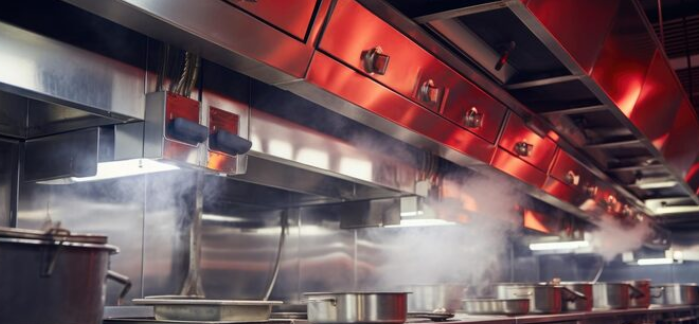
A kitchen fire suppression system in Dammam is an automatic wet chemical system fitted over cooking appliances, the hood and the exhaust duct. When it detects a grease fire it discharges agent onto the hazard and can shut off gas or electricity. Kites Safety designs, supplies, installs, tests and maintains these systems from its Ad Dammam office.
A fryer flare-up can reach the filters in seconds, and from there the exhaust duct carries fire out of sight. Commercial kitchens in Dammam use an automatic suppression system to stop it at the source. Kites Safety, based in Ar Rabi, Ad Dammam, covers design, supply, installation, testing and maintenance. Request a site survey or a quotation, and the first visit starts with your own hood, duct and appliance line.
Request a Site Survey or Quotation
Talk to Kites Advanced Fire & Safety Company in Ad Dammam: call +966 592 066 358 or email enquiry@kitessafety.com.
How Kites Safety Approaches Commercial Kitchen Fire Protection in Dammam
Kites Advanced Fire & Safety Company calls itself a kitchen fire and safety specialist and states 10+ years of experience. As a kitchen fire suppression system contractor Dammam operators can visit in person, it works from 4986 King Khalid - Ar Rabi, Unit No.6, Ad Dammam 32241-8167, Kingdom of Saudi Arabia, and its about page lists Khobar, Dhahran, Jubail, Riyadh and Jeddah as further coverage. Where a location stretches its response time, the company says it tells you before you commit.
Its work runs from site survey and design through supply, installation, testing and commissioning, then inspection, refilling, preventive maintenance and annual maintenance contracts, with a 24x7 emergency line. One contractor for every stage keeps design records and service records in the same hands. Its customers page names 12 client organisations, including Rawabi, Al-Essa for Contracting and Al Rushaid Construction.
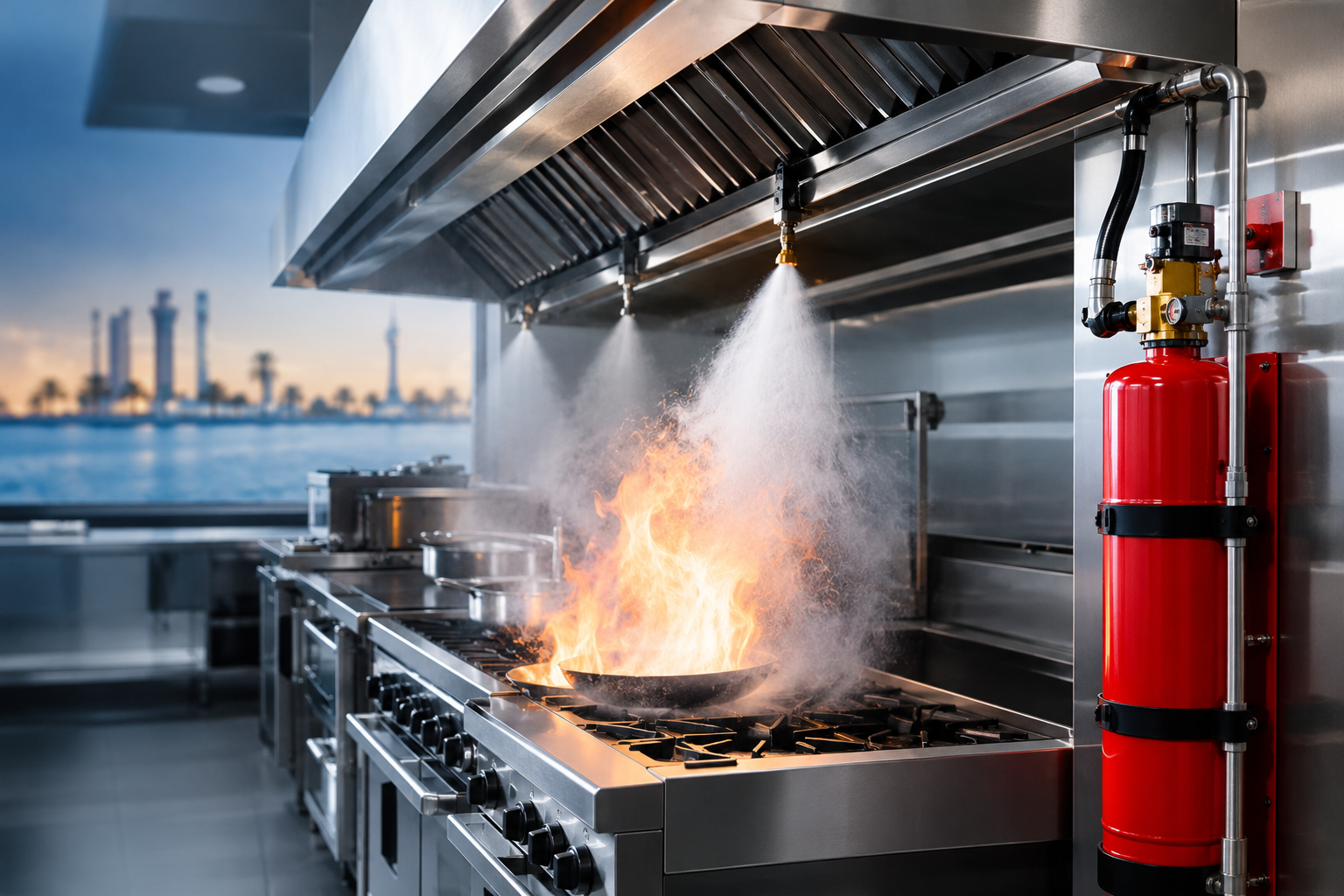
Commercial Kitchen Fire Suppression Systems for Different Cooking Hazards
A grease fire does not stay at the appliance. It climbs into the hood, filters, plenum and duct, which is why kitchen exhaust fire protection counts as much as coverage over the cooking line. Commercial cooking fire protection has to follow that whole path.
| Hazard | What the design considers |
|---|---|
| Fryers, griddles, ranges and woks | Each appliance is classified by fuel load and splash pattern, which sets its nozzle type, position and flow number |
| Charbroilers, lava rock grills, rotisseries and BBQ stations | Open-flame cooking that heats the hood and duct directly, so the exhaust path is protected with the appliance |
| Hoods, filters, plenums and ducts | Grease collects here; long duct runs add pipework and nozzles |
| Gas and electrical supply | A gas shut-off valve interlocked with the system, plus electrical shutdown and alarm interfaces where required |
Kites' installation and refilling pages describe a wet chemical agent, the type normally used on cooking oils and fats. Cylinder count, pipe runs and nozzles come from the kitchen's layout and appliance mix, checked for worst-case simultaneous discharge, not from a catalogue kit. For commercial cooking equipment fire protection that matches the real kitchen, the survey comes first. See the equipment we protect page for the full list; the wider explanation sits on the kitchen fire suppression systems page.
Which Commercial Kitchens in Dammam Need a Fire Suppression System?
Any commercial kitchen with grease-producing equipment under a hood is generally expected to have an approved automatic system; the local Civil Defense office confirms requirements site by site. The table follows Kites' industries page.
| Kitchen type | What changes the design |
|---|---|
| Restaurants, cafes, fast food and cloud kitchens | Menus and appliances change often, so coverage needs reviewing after every equipment change |
| Hotels, resorts and serviced apartments | Each kitchen is designed on its own hazard, and banqueting kitchens get heavy use |
| Hospitals and medical facilities | Kitchens run continuously and cannot close for works, so documentation matters |
| Airports, shopping centres and government buildings | Several food operators share one exhaust, so where each system starts and ends is a design question |
| Industrial and catering kitchens | Heavy-duty appliances and long duct runs build grease faster, so inspection intervals follow actual use |
Not sure yours qualifies? A commercial kitchen fire safety assessment settles it. The surveyor measures the hood, duct and plenum, lists every appliance under the hood and records the gas and electrical arrangement, then states what the kitchen needs.
Designing and Installing a Kitchen Fire Suppression System in Dammam
Restaurant kitchen fire protection services differ from a catalogue sale because the installed kitchen, not the drawing, is what the system must protect. Kites' design and engineering work follows six stages.
1. Site survey: hood, duct and plenum measured, every appliance listed, gas and electrical supply recorded.
2. Hazard evaluation and design: agent volume, cylinder count, pipe runs and nozzles calculated, then checked for worst-case simultaneous discharge.
3. Equipment selection and compliance review: cylinders, detection line, nozzles, gas valve and manual pull station specified as one matched set and checked against applicable fire code requirements.
4. Installation: detection line routed through hood and duct, pipework run to each nozzle, pull station on the egress route, gas valve interlocked. Disruptive work is scheduled overnight or between services.
5. Testing and commissioning: detection, release, gas shut-off and electrical shutdown tested as one sequence, with nozzle aim checked against the design.
6. Handover: a commissioning record, the system drawing and a component schedule, and training for kitchen staff on the manual pull station and the response after a discharge.
Have these ready for the survey:
- The appliance list
- Hood and duct dimensions, if available
- The gas supply arrangement
- Any fire authority correspondence already received
Saudi Civil Defense and Commercial Kitchen Fire Safety Requirements
Kites states that kitchen suppression installations are reviewed under Saudi Civil Defense and Saudi Building Code requirements. No contractor grants approval; only the authority does. Safety licensing runs through the General Directorate of Civil Defense and its Salama platform, and a licensing consultancy's guide says inspectors check restaurants and cafes with cooking equipment for kitchen-hood suppression, a detection and alarm panel and emergency lighting. Confirm current steps on the official portal.
Technical standards sit underneath. NFPA 17A covers the design, installation, testing and maintenance of wet chemical extinguishing systems, NFPA 96 covers ventilation control and fire protection of commercial cooking operations, and UL 300 is the usual test reference for commercial cooking systems. Which editions apply to your premises is for Civil Defense and your contractor to confirm. Kites' fire safety requirements for restaurants post covers the background.
Keep four records on site for any inspector or insurer: the commissioning record, the system drawing and component schedule, written inspection reports, and a log of staff training.
Kitchen Fire Suppression System Maintenance and Refilling in Dammam
A system that was right at commissioning drifts out of line when appliances move or menus change. Kitchen suppression system inspection checks cylinder pressure, detection line tension, fusible links, nozzles, pipework, the pull station and interlocks, and whether appliances have moved or changed since the design. Kitchen fire suppression system servicing after a discharge means refilling and recharge: a damage check, replacement of fusible links, cartridges, seals and nozzle caps, a refill with the correct wet chemical agent, a reset and a functional test before the kitchen is signed back as protected. The maintenance page has the checklist, and annual maintenance contracts add scheduled visits, priority technical support and maintenance reporting.
The intervals below follow the 2021 editions of NFPA 17A and NFPA 96 as summarised by Inspect Point in March 2026.
| Task | Interval | Who |
|---|---|---|
| Check of the suppression system | Monthly | Owner or agent |
| Inspection and service of the suppression system | Semiannual | Trained and certified person |
| Hood, duct and fan cleaning: solid fuel cooking | Monthly | Trained, qualified and certified company |
| Hood, duct and fan cleaning: high-volume cooking (24-hour, charbroiling, wok) | Quarterly | Same |
| Hood, duct and fan cleaning: moderate-volume cooking | Semiannual | Same |
| Hood, duct and fan cleaning: low-volume cooking | Annual | Same |
Kites' own inspection page sets no fixed interval: it says intervals come from the applicable fire code, the manufacturer and the local fire authority, and that it confirms the cycle at the first inspection. Source for the table: Inspect Point. After any discharge, call the 24x7 line on +966 592 066 358.
Kitchen Fire Suppression System Cost in Dammam
Kites does not publish prices. Its pages route cost to a site survey and a written quote, and its maintenance contract page says scope is confirmed in writing before the contract starts. That is sensible, because two kitchens of the same size can need very different systems. Six things move the figure.
| Factor | Why it changes the quote |
|---|---|
| Appliance line and fuel load | More or heavier appliances need more nozzles and flow capacity |
| Hood, plenum and duct size | Longer runs mean more pipework and nozzles |
| Cylinder size and count | Agent volume is calculated against the hazard |
| Shut-offs and interfaces | Gas valve, electrical shutdown and alarm connections add components |
| Site conditions | Working around service hours, overnight if needed, adds planning |
| Service plan | A one-off inspection or refill costs differently from an annual contract |
Some costs sit outside the system quote. A licensing consultancy's 2026 guide lists indicative Civil Defense licence fees of about SAR 1,000 to 3,000 for restaurants and mid-risk premises, and equipment-and-maintenance contracts of about SAR 1,500 to 6,000 or more a year for premises generally. These are third-party estimates, not Kites' prices, and the guide itself says to confirm current figures on the official portal (Noble Core KSA).
Request a Kitchen Fire Suppression Site Survey in Dammam
- +966 592 066 358
- enquiry@kitessafety.com
- 4986 King Khalid – Ar Rabi, Unit No.6, Ad Dammam 32241-8167, Kingdom of Saudi Arabia
Request a quote
Fastest response: message us on WhatsApp or email enquiry@kitessafety.com.
Frequently Asked Questions
How Does a Commercial Kitchen Fire Suppression System Work?
A detection line routed through the hood and duct senses fire heat at fusible link positions and releases wet chemical agent through pipework to nozzles aimed at the appliances, hood and duct. The gas valve is interlocked to close, and a manual pull station allows release by hand. After a discharge the system must be refilled, recharged and tested.
Is a Kitchen Hood Fire Suppression System Required in Dammam?
A commercial kitchen with grease-producing equipment under a hood is generally expected to have an approved automatic system. Saudi Civil Defense and the Saudi Building Code govern the requirement. Confirm it for your premises with the local Civil Defense office before you buy.
How Much Does a Kitchen Fire Suppression System Cost in Saudi Arabia?
There is no fixed price. Cost depends on the appliance line, hood and duct size, cylinder count, shut-off and alarm interfaces, site conditions and the service plan. Kites Safety does not publish prices and quotes after a site survey, so ask for the quote in writing with the scope itemised.
How Often Should a Kitchen Fire Suppression System Be Inspected?
Under NFPA 17A, as summarised by Inspect Point for the 2021 edition, a trained and certified person should inspect and service the system semiannually, with a monthly check by the owner. Kites Safety sets the cycle for each site at the first inspection, following the fire code, the manufacturer and the local fire authority.
Does Kites Provide Kitchen Fire Suppression Maintenance in Dammam?
Yes. Kites Safety, based in Ad Dammam, lists inspection services, refilling and recharge, preventive maintenance, annual maintenance contracts and 24x7 emergency service support. Call +966 592 066 358 to arrange a visit.
A kitchen fire suppression system in Dammam earns its cost on the one night it is needed, and only if it was designed for the kitchen as it is now. Start with a survey of yours.
Serving Dammam, Khobar, Dhahran, Jubail, Riyadh, Jeddah and commercial kitchens Kingdom-wide from our base in Ad Dammam.