
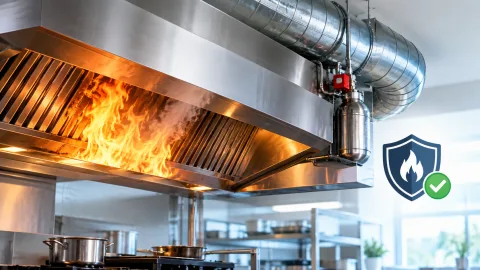
How to Handle a Grease Fire in a Commercial Kitchen: What Staff Should and Should Never Do
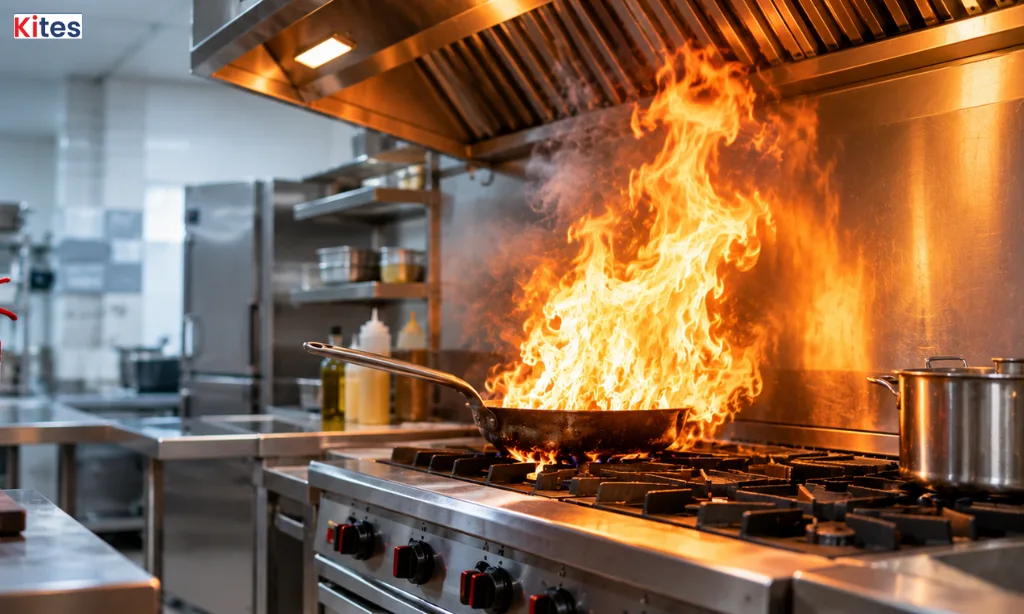
How to handle a grease fire in a commercial kitchen: turn off the heat if it's safe to reach, then smother the flames with a metal lid, baking sheet or a Class K fire extinguisher. Never pour water on a grease fire; it flashes to steam instantly and throws burning oil into the air. If the fire grows beyond a small, contained flame, evacuate immediately and call emergency services.
Cooking oil heated past its flash point can ignite within seconds, and once alight it spreads across a cooking surface far faster than most staff expect from a stovetop fire. What happens in the first few seconds after that, reaching for water instead of a lid, trying to move a burning pan, or freezing instead of acting, is usually what decides whether a fire stays a small kitchen incident or becomes an evacuation.
Kites Advanced Fire & Safety designs and maintains commercial kitchen fire suppression systems across Saudi Arabia, and this guide covers what staff should do during a grease fire, what to never do, what causes most of these fires, and how a properly designed suppression system changes the outcome before a person even reaches for an extinguisher.
What Is a Grease Fire?
A grease fire is a Class K fire, cooking oil or animal fat heated past its flash point until it ignites on its own, without needing an external spark. This is different from an ordinary Class A fire involving paper, wood or fabric, and it behaves differently too: the burning fuel is a liquid that floats, spreads, and reacts violently with water rather than being extinguished by it.
Commercial kitchens see this risk multiplied across several appliances at once, deep fryers, griddles, woks and charbroilers, each running hot oil or fat for hours at a stretch under a grease-laden exhaust hood that can carry a fire well past the appliance where it started. A single fryer left unattended for even a few minutes at the wrong temperature is enough; the fire doesn't need a spark, a spilled ingredient, or any other trigger beyond the oil itself reaching its ignition point.
What Should Staff Do During a Grease Fire?
What to do during a grease fire comes down to a short, fixed sequence, followed in order rather than improvised in the moment. The lid-smothering step below matches guidance from the U.S. Fire Administration on covering a pan fire rather than any improvised technique:
- Turn off the heat source immediately, only if it can be reached without leaning over the flames
- Smother the fire by sliding a metal lid, tray or baking sheet completely over the pan or fryer, covering it entirely to cut off oxygen
- Leave the lid in place and do not move or lift it until the pan has fully cooled, reigniting is common if air reaches the oil again too soon
- Use a Class K fire extinguisher if a lid isn't within reach or the fire is already larger than the pan itself
- Activate the kitchen's fire suppression system pull station if the fire is on the cooking line and the system hasn't already triggered automatically
- Evacuate and call 998 immediately if the fire spreads beyond the appliance, reaches the hood or duct, or isn't fully out within seconds
Every step above assumes the fire is still small and contained. The moment it isn't, the correct action changes from firefighting to evacuation, and no step on this list is worth staying in the room to complete.
What Should You NEVER Do During a Grease Fire?
A few instinctive reactions make a grease fire worse, sometimes catastrophically so, and staff training should rule these out explicitly rather than assume common sense will:
- Never pour water on a grease fire. Water sinks below the burning oil, flashes to steam almost instantly, and throws burning grease into the air as a fireball
- Never use flour, baking powder or sugar, these are not the same as baking soda's smothering effect in small stovetop fires, and some are combustible themselves
- Never try to carry a burning pan to a sink, doorway or outside; moving it feeds it oxygen and risks spilling burning oil along the way
- Never use a standard ABC dry chemical or water-based extinguisher on a grease fire unless it's rated for Class K; the wrong agent can spread burning oil rather than smother it
- Never remove a lid or cloth covering the fire to check if it's out; reopening it before the pan has cooled is a common cause of reignition
Grease Fire Response at a Glance
| Situation | Correct Response | Never Do This |
|---|---|---|
| Small, contained pan or fryer fire | Turn off heat, smother with a lid or Class K extinguisher | Pour water, use flour or sugar |
| Fire spreading to the hood or duct | Evacuate, activate the suppression system pull station, call 998 | Try to fight it with a portable extinguisher alone |
| Fire not out after first response | Leave immediately, close doors, call 998 | Reopen the lid to check, or try a second technique |
How Does a Kitchen Fire Suppression System Help During a Grease Fire?
A kitchen fire suppression system detects heat above the cooking line automatically and discharges a wet chemical agent onto the appliance, hood and duct within seconds, well before a staff member could reach for a lid or extinguisher. The system also cuts gas or electrical power to the cooking equipment on activation, removing the fuel source rather than only the flame. For the mechanics behind this, see Kites' guide to how a kitchen fire suppression system works).
| Factor | Portable Class K Extinguisher | Automatic Suppression System |
|---|---|---|
| Response speed | Depends on staff reaching it and reacting correctly | Triggers automatically within seconds of detecting heat |
| Coverage | Appliance surface only, where aimed | Appliance, hood and duct together |
| Requires a person present | Yes | No, works even if the kitchen is briefly unattended |
| Typical role | First-response backup, small fires | Primary protection, required on most commercial cooking lines |
A commercial hood fire suppression system specifically is what protects the exhaust path a grease fire actually spreads through, since grease accumulates inside hoods and ducts over time and a fire that reaches it can travel well past the cooking line. A portable extinguisher never reaches that duct-level risk on its own, which is why Saudi Civil Defense treats the two as complementary rather than substitutes for each other.
What Causes Most Grease Fires in Commercial Kitchens?
A small number of causes account for most commercial kitchen grease fires:
- Unattended cooking oil left on high heat, even briefly, during a busy service
- Grease buildup inside hoods, plenums and ducts that hasn't been cleaned on schedule
- Overfilled fryers, where oil is more likely to spill or splash onto a burner or heating element
- Damaged or poorly maintained equipment, a faulty thermostat that overheats oil past its flash point
- Flammable material, packaging, cloths, paper, stored too close to fryers and grills
How Can Restaurants Prevent Grease Fires?
Grease fire prevention comes down to a handful of consistent habits rather than any single fix: never leaving hot oil unattended, keeping fryers filled to their marked level rather than guessing, and following a fixed hood and duct cleaning schedule rather than one triggered only after a visible grease buildup appears. Regular equipment checks, thermostats, thermocouples, and burner condition, catch the kind of fault that quietly overheats oil past a safe threshold.
None of these habits replace a fire suppression system; they reduce how often it's ever called on to do its job. A kitchen that treats hood cleaning as a fixed, dated schedule rather than a task done only when buildup becomes visible is, in practical terms, running a materially lower grease fire risk than one that doesn't, regardless of how careful individual staff members are on any given shift.
How to Handle a Grease Fire in a Commercial Kitchen: Safety Checklist
- ☐ Class K fire extinguisher mounted within reach of every fryer and grill
- ☐ Metal lids or baking sheets kept near cooking surfaces, not stored away
- ☐ Fire suppression system pull station clearly visible and unobstructed
- ☐ Hood and duct cleaning on a fixed, documented schedule
- ☐ Fryers checked for correct oil level before each shift
- ☐ All kitchen staff trained on the do/never-do sequence, not just management
- ☐ Suppression system inspected and tagged per its required maintenance interval
- ☐ Evacuation route from the kitchen clear of obstructions at all times
- ☐ 998 and the facility's own emergency contact posted visibly in the kitchen
When Should a Commercial Kitchen Have a Fire Suppression System?
Any commercial kitchen with a cooking line under a ventilation hood, fryers, griddles, ranges or charbroilers, needs a kitchen hood fire suppression system as a standard requirement under Saudi Civil Defense and Saudi Building Code rules, generally confirmed before the kitchen opens rather than retrofitted after an incident. A new facility, a renovated kitchen, or a change in cooking equipment are the three points at which this gets checked most often, and all three should trigger a review rather than an assumption that the existing system still covers the current layout. Kites covers the specific requirements in more detail in its commercial kitchen fire safety requirements guide.
Why Professional Kitchen Fire Suppression Design Matters
A commercial hood fire suppression system sized against a generic template rather than the kitchen's actual equipment and layout can look complete while leaving real gaps, incomplete duct coverage, incorrect nozzle placement, missing gas shutdown integration. These gaps rarely show up on a casual look and only surface when the system is actually tested by a real fire. Kites has covered this in detail separately in its guide to common kitchen fire suppression installation mistakes, which is worth reading alongside this piece for anyone specifying or reviewing a system design.
What Should Staff Do After a Grease Fire?
Once a fire is fully out, the response isn't finished. Leave the affected equipment off and unused until it's been checked, ventilate the area, and inspect the duct and surrounding surfaces for hidden embers or residual heat before assuming the incident is over. Report the incident to management regardless of how minor it seemed, and if the suppression system discharged, have it professionally recharged and re-certified before the kitchen reopens; a discharged system offers no protection until that's done.
Protect Your Commercial Kitchen From Fire Risks
Kites Advanced Fire & Safety designs, installs and maintains commercial kitchen fire suppression systems across Saudi Arabia. Call +966 592 066 358 (24x7) or email enquiry@kitessafety.com for a kitchen fire risk assessment, or explore Kites' kitchen fire suppression systems.
Frequently Asked Questions
What should you never do during a grease fire?
Never pour water onto a grease fire. Water sinks below the burning oil, flashes to steam almost instantly, and throws burning grease into the air as a fireball. Never use flour, sugar or baking powder either, and never try to carry a burning pan outside.
What is the fastest way to put out a small grease fire?
Turn off the heat source if it's safe to reach, then smother the flames by sliding a metal lid or baking sheet completely over the pan and leaving it in place until the pan has cooled. A Class K fire extinguisher is the next option if a lid isn't available or the fire is already larger than the pan.
Can you use a regular fire extinguisher on a grease fire?
A standard ABC dry chemical extinguisher is not the right tool for a commercial kitchen grease fire; a Class K extinguisher, designed for cooking oil and animal fat fires, is what commercial kitchens should have on hand near cooking lines.
How does a kitchen fire suppression system help during a grease fire?
A kitchen fire suppression system detects heat above the cooking line automatically, discharges a wet chemical agent onto the appliance, hood and duct within seconds, and shuts off the gas or electrical supply to the cooking equipment, acting faster and more completely than a person reaching for a portable extinguisher.
What causes most grease fires in a commercial kitchen?
Unattended cooking oil left on high heat, grease buildup inside hoods and ducts that haven't been cleaned on schedule, and overfilled fryers are the most common causes of grease fires in commercial kitchens.
When should a commercial kitchen have a fire suppression system installed?
Any commercial kitchen with a cooking line under a ventilation hood, fryers, griddles, ranges, charbroilers or similar equipment, needs a fire suppression system as a standard requirement under Saudi Civil Defense and Saudi Building Code rules, generally confirmed before the kitchen opens rather than added afterward.
What should staff do immediately after a grease fire is out?
Do not resume cooking on the affected equipment, ventilate the area, check for hidden embers or heat in the duct and surrounding surfaces, report the incident to management, and have the fire suppression system, if it discharged, professionally recharged and inspected before the kitchen reopens.
Need help with kitchen fire suppression? Contact Kites
0 Comments
Leave a comment
More from the blog
Related articles
Fire Safety Requirements for Restaurants and Commercial Kitchens in Saudi Arabia
Fire safety requirements for restaurants in Saudi Arabia: suppression, extinguishers, alarms, exits, gas and electrical safety, and inspection, explained.