Types of Kitchen Fire Suppression Systems for Commercial Kitchens
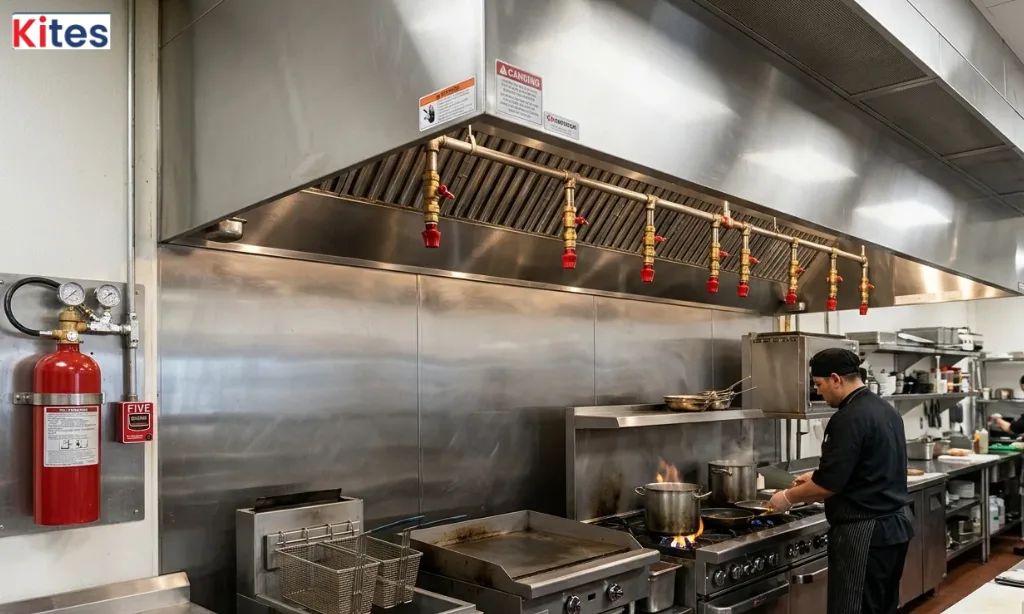
The main types of kitchen fire suppression systems are wet chemical, dry chemical and water mist. Wet chemical is the standard choice for grease and cooking oil fires because it smothers and cools the fuel. Dry chemical and water mist suit narrower cases, and the right choice depends on your cooking equipment and exhaust layout.
A fryer thermostat fails during the Thursday dinner rush, the oil overheats and ignites, and within minutes the flames are inside the hood. A handheld extinguisher cannot reach the plenum or the duct above it. Commercial kitchens carry fire risks that ordinary buildings do not: fryers, grills, ranges and woks produce grease-laden fires that spread through the exhaust path. That is why a kitchen needs a suppression system designed around its actual cooking equipment and exhaust configuration. This guide explains the types, where each fits, and how to choose in Saudi Arabia.
What Is a Commercial Kitchen Fire Suppression System?
A commercial kitchen fire suppression system is a fixed, automatic installation that detects a fire over cooking equipment and the exhaust hood, discharges an extinguishing agent through fixed nozzles, and cuts the fuel and power to the appliances. It works without anyone reaching for an extinguisher, which matters because these fires start under hoods, behind fryer lines and inside ducts. A kitchen hood fire suppression system protects the appliances, the hood, the plenum and the duct as one connected hazard, and it is separate from the building's sprinklers, though normally wired to the alarm.
What parts make up the system?
Commercial kitchen fire suppression systems of every type share the same basic parts, and each is a point to check at inspection. The full sequence is explained in our guide to how a kitchen fire suppression system works.
| Component | What it does | What to check |
|---|---|---|
| Agent cylinder | Stores the extinguishing agent under pressure | Pressure or weight, tamper seals, refill and test dates |
| Detection | Fusible links or thermal detectors in the hood and duct trigger release | Temperature rating suits the hood; no grease buildup on links |
| Piping and nozzles | Carry the agent to each hazard | Nozzle type, aim and caps, especially after equipment is moved |
| Manual release station | Lets staff trigger the system by hand | Reachable, labelled, on the exit route |
| Gas and electrical shutdown | Cuts fuel and power to the appliances | Fuel actually stops when the system trips |
| Alarm interface | Sends the signal to the building alarm | Signal reaches the panel and the staff |
Need to protect a commercial kitchen? Get a professional kitchen fire protection assessment from Kites Safety.
Main Types of Kitchen Fire Suppression Systems
The agent decides what a system can and cannot do. Three types matter for commercial cooking, plus a fourth consideration: kitchens whose hazards do not fit the standard line.
The agent decides what a system can and cannot do. Three types matter for commercial cooking, plus a fourth consideration: kitchens whose hazards do not fit the standard line.
1. Wet Chemical Fire Suppression Systems
A wet chemical fire suppression system discharges a water-based alkaline solution, typically potassium-based. On hot cooking oil it reacts to form a soapy layer that seals the surface from oxygen, a process called saponification, while the liquid cools the fuel and lowers the chance of re-ignition. These systems are designed and installed to NFPA 17A and tested to UL 300 for commercial cooking equipment. They cover fryers, griddles, ranges, woks, charbroilers and the hood and duct above them. The agent is water-soluble, so cleanup is lighter than with powder. Our deeper explanation sits in the post on how wet chemical fire protection works.
Planning a commercial kitchen? Kites Safety can assess your cooking equipment and recommend the appropriate suppression system.
2. Dry Chemical Fire Suppression Systems
Dry chemical systems discharge a fine powder, commonly sodium bicarbonate or monoammonium phosphate. The powder interrupts the combustion reaction and knocks flames down fast, but it does not cool the oil. Hot oil can re-ignite once the powder settles. The residue also coats food-preparation surfaces and equipment, and it takes real effort to clean. NFPA 17 is the governing standard. Dry chemical is mostly an older kitchen technology now, though it survives in legacy installations and some non-cooking hazard areas.
The NIST residential cooktop tests show the gap. In NIST Technical Note 1969, the one hood-installed dry chemical system tested failed to extinguish the oil fire in all experiments, while one hood-installed wet chemical system extinguished it in every test. The report covers residential kitchens, so treat it as indicative evidence, not a verdict on commercial UL 300 systems.
3. Water-Based and Water Mist Fire Suppression Systems
Water alone is the wrong tool for burning cooking oil. Water sinks below the oil, flashes to steam and can throw burning oil outward. This is why building sprinklers do not replace a kitchen suppression system over the cooking line. Water mist is different. High-pressure nozzles break water into very fine droplets that cool the flame and displace oxygen, with little chemical residue. NFPA 750 covers these systems. Some manufacturers offer water mist systems tested for specific kitchen hood applications, but approvals are product-specific, so check the listing against your exact equipment before assuming a fit. In the same NIST residential tests, one of three water mist systems succeeded and two did not. Not sure which suppression system suits your kitchen? Ask Kites Safety for an application assessment.
4. Specialised Systems for Different Kitchen Hazards
Not every kitchen is a fryer line and a range. Solid-fuel cooking such as charcoal grills and wood-fired or tandoor-style ovens produces hotter, longer-burning fires and needs a design reviewed for that exact appliance. Charbroilers, lava rock grills, rotisserie equipment and BBQ stations are common in grill-led menus across the Kingdom, and each needs its own nozzle coverage. Multi-hood hotel and catering kitchens need a plan for every hood, not one system sized to the largest.
Which Kitchen Fire Suppression System Is Best for Your Commercial Kitchen?
No single system suits every kitchen. For a restaurant fire suppression system built around frying, grilling or searing in oil, that points to wet chemical. Dry chemical and water mist belong in the conversation only when a designer can show a listing for your exact equipment.
Wet Chemical vs Dry Chemical vs Water Mist
| Column 1 | Column 2 | Column 3 | Column 4 |
|---|---|---|---|
| How it acts | Smothers and cools; forms a soapy layer on hot oil | Smothers flame; no cooling effect | Cools and displaces oxygen with fine droplets |
| Best fit | Fryers, griddles, ranges, woks, charbroilers, hood and duct | Legacy installations; some non-cooking hazards | Specific listed hood applications |
| Main limit | Must be matched to each appliance and re-checked when equipment changes | Re-ignition risk on hot oil; heavy powder residue | Product-specific approvals; needs a water supply and pump |
| Standard | NFPA 17A, UL 300 test | NFPA 17 | NFPA 750 |
| Cleanup | Water-soluble, lighter | Powder spreads, harder | Mostly water |
A five-step way to decide
- List every appliance and its fuel: electric, gas or charcoal.
- Measure the exhaust path. Hood size, filter type and duct run all decide nozzle placement.
- Note what sits beside the line: gas valves, electrical panels, storage, other hoods.
- Ask the supplier for the listing and installation standard for each appliance, not a general brochure.
- Confirm the approval route with your local Civil Defense office before you buy, because requirements can vary by site type.
Kitchen Fire Suppression Standards and Compliance in Saudi Arabia
Saudi projects are reviewed against the Saudi Building Code, whose fire volume is SBC 801, the Saudi Fire Code, and approval runs through the General Directorate of Civil Defense, as our guide to fire safety requirements for restaurants in Saudi Arabia explains. International standards are the technical reference for the system.
| Standard | What it covers | Why it matters to an owner |
|---|---|---|
| NFPA 17A | Wet chemical extinguishing systems: design, installation, testing, maintenance | The reference for the most common kitchen system type |
| NFPA 17 | Dry chemical extinguishing systems | Relevant if you inherit an older installation |
| NFPA 750 | Water mist fire protection systems | Relevant if a water mist product is proposed |
| NFPA 96 | Ventilation control and fire protection of commercial cooking operations | Covers the hood, duct and cleaning that suppression depends on |
| UL 300 | Fire testing of extinguishing systems for commercial cooking equipment | Shows a system was tested against realistic cooking fires |
| SBC 801 | Saudi Fire Code | The code that Saudi plan reviews refer to |
Confirm the exact clause, the code edition and any site-specific requirement with your local Civil Defense office before specifying equipment.
Common Mistakes When Choosing a Kitchen Fire Suppression System
Installation errors have their own list in our post on installation mistakes. These mistakes happen earlier, at the selection stage. Choosing on price per nozzle is the first. A quote that covers fewer appliances is cheaper only until an inspector counts them. The second is specifying for last year's line: adding a fryer or a charbroiler without re-checking nozzle coverage leaves a new hazard unprotected. The third is ignoring the exhaust. The hood, plenum and duct are where a grease fire spreads, so a design that covers only the cooktop is incomplete. Fourth, owners assume the building sprinklers cover the kitchen. They do not suit burning oil. Last, some buy without a documented site survey, so nobody records what the system was designed to protect.
Why Regular Kitchen Fire Suppression Maintenance Matters
Commercial kitchen fire safety does not end at installation. A system that was correct on commissioning day can be wrong six months later. Grease coats detection links, nozzles get capped or moved, cylinders lose pressure, and new equipment arrives. Inspection is commonly scheduled every six months, though the interval depends on the fire code, the manufacturer and the local fire authority. Our kitchen suppression system maintenance page sets out the areas an inspection covers.
After a discharge the kitchen is unprotected until the system is recharged and re-tested, so recharge and emergency support matter as much as the original installation.
Working With a Kitchen Fire Suppression Contractor in Saudi Arabia
Kites Safety is a commercial kitchen fire suppression specialist based at 4986 King Khalid, Ar Rabi, Unit No.6, Ad Dammam 32241-8167. Its published service pages describe a six-stage process: site survey, design, supply and installation, testing and commissioning, inspection, and ongoing maintenance, with 24x7 emergency support on +966 592 066 358. Coverage includes Dammam, Khobar, Dhahran, Jubail, Riyadh and Jeddah, plus commercial kitchens across the Kingdom. For the equipment it protects, see equipment we protect, and for hood systems specifically, the kitchen hood fire suppression system page. The company's service pages centre on wet chemical systems; if you are comparing a different agent, send the equipment list and ask which approach it supports. For other locations, check coverage by contacting the team directly.
Planning a new commercial kitchen or upgrading an existing fire suppression system? Contact Kites Safety for a site assessment.
Frequently Asked Questions
What are the main types of kitchen fire suppression systems?
The main types are wet chemical, dry chemical and water mist. Wet chemical is the standard for grease and oil fires in commercial kitchens. Dry chemical appears mostly in older installations, and water mist applies only to specific listed hood applications.
Which fire suppression system is best for a commercial kitchen?
For kitchens that fry, grill or sear with oil, a wet chemical system designed to NFPA 17A is the usual choice. The final decision depends on the appliances, fuel types and exhaust layout, so ask for a site survey before specifying.
Is wet chemical better than dry chemical for a restaurant?
For cooking oil fires, generally yes. Wet chemical cools the oil and reduces re-ignition, while dry chemical only smothers the flame and leaves powder residue. NIST residential tests showed the same pattern, though they were not commercial UL 300 tests.
Can sprinklers or water mist replace a wet chemical system?
Building sprinklers do not replace a kitchen suppression system, because water is unsuitable for burning oil. Water mist can be used only where a product is listed for your specific kitchen hood application, so check the approval first.
Do restaurants in Saudi Arabia need a kitchen fire suppression system?
Commercial kitchens that produce grease-laden vapour are generally expected to have an approved system reviewed under Saudi Civil Defense and the Saudi Building Code. Confirm the exact requirement for your site type with your local Civil Defense office.
How often should a kitchen fire suppression system be inspected?
Inspection is commonly every six months. The actual interval depends on the applicable fire code, the manufacturer's instructions and the local fire authority, so confirm it for your installation.
What should I do after a kitchen fire suppression system discharges?
Make the area safe and call the fire service if the fire is not fully out. Then arrange recharge, nozzle checks and re-testing through a qualified contractor; the kitchen is unprotected until then. General information only: system design and approval depend on your site, the code edition and Civil Defense.
About the Author
• Kites Safety (Kites Advanced Fire & Safety Company) is a commercial kitchen fire suppression specialist in Ad Dammam, Saudi Arabia, offering design, supply and installation, testing, inspection, refilling, maintenance contracts and 24x7 emergency support. About Kites Safety • Reviewed by L K Monu Borkala, a digital marketing strategist with 20+ years of SEO experience and over 650 client campaigns across India and UAE. As a founding member of OneCity Technologies, Bangalore, he oversees content strategy, editorial compliance, and SEO frameworks across education, business services, and digital marketing verticals.
Need help with kitchen fire suppression? Contact Kites
0 Comments
Leave a comment
More from the blog