7 Signs Your Facility Needs an Automatic Fire Suppression System
A commercial kitchen needs an automatic fire suppression system when grease fires have already happened, hood and duct grease is building up, fryers or grills share one cooking line, existing protection ignores the cooking hazard, the layout has changed, servicing has lapsed, or compliance is unconfirmed. Any one sign justifies a professional assessment.
Cooking caused 30% of US nonresidential building fires between 2017 and 2019, the largest single cause, according to the US Fire Administration (USFA). A Saudi commercial kitchen carries the same hazards: cooking oil that ignites fast, grease coating hoods and ducts, high-heat fryers and grills, and gas lines that feed a flame. A correctly designed and installed automatic fire suppression system detects heat above the cooking line and discharges at the source. Recurring grease fires, unprotected appliances, dirty hoods and outdated protection all point to one next step: a professional fire risk assessment.
Request a Kitchen Fire Safety Assessment from Kites Safety on +966 592 066 358 or enquiry@kitessafety.com.
Key Warning Signs Your Commercial Kitchen Fire Suppression System Needs Attention
Not every sign means a failed commercial kitchen fire suppression system. Some mean no system at all, and some mean a system that no longer matches the kitchen. The table lists what to check today; seven sections explain each sign.
| Sign | What you can check today | First step |
|---|---|---|
| 1. Grease fires nearby | Incident log, flare-up reports, scorched hood edges | Log each event; review that appliance |
| 2. Grease in hood and ducts | Dripping grease, saturated filters, duct residue | Book cleaning to match cooking volume |
| 3. Many high-heat appliances | Fryers, grills and ranges under one hood | Request a hazard review of the line |
| 4. Protection that ignores cooking | Only sprinklers or extinguishers over the line | Name what covers each appliance |
| 5. Layout changed | Any appliance moved, added or replaced | Tell the contractor before the next service |
| 6. Outdated or poorly kept | Service tag date, nozzle caps, pull station access | Book an inspection now |
| 7. Compliance unconfirmed | Approval and service paperwork on site | Confirm the requirement with Civil Defense |
1. Grease Fires Have Occurred Near Your Cooking Equipment
A flare-up that a cook smothered with a lid still counts. It shows that an appliance can start a fire, and the next one may begin while nobody stands at that burner. The USFA found that 95% of cooking fires in nonresidential buildings from 2017 to 2019 were small and confined, which is exactly why they get shrugged off. Keep a written log: appliance, time, what put it out. Two entries against the same fryer make a pattern, and a pattern justifies asking a contractor to review that cooking line. What staff should do in the moment is a separate subject, covered in our guide to handling a grease fire in a commercial kitchen.
2. Grease Is Building Up Inside the Kitchen Hood and Exhaust Ducts
Filters catch a large share of the grease in the air, but some always passes through and settles in the plenum and the duct, where nobody looks until it is thick. Practical checks: grease dripping from the lower edge of the hood, filters that turn saturated soon after cleaning, and residue visible at a duct access panel. NFPA 96 ties cleaning frequency to the cooking type. In Inspect Point's summary of the 2021 edition, solid fuel cooking is monthly, high-volume cooking (24-hour, charbroiling, wok) is quarterly, moderate volume is semiannual and low volume is annual. Cleaning removes the fuel; suppression handles the fire that starts anyway. How these fires begin is covered in our guide to kitchen hood and duct fires.
3. Your Kitchen Has Fryers, Grills or Multiple High-Heat Appliances
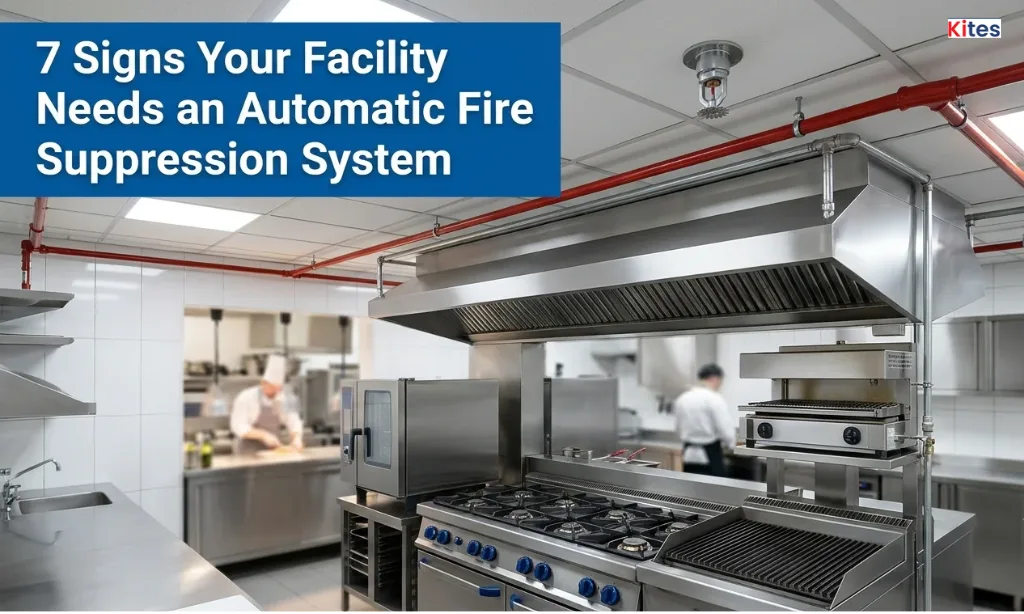
More appliances under one hood means more ignition points and a harder design job. Kites lists deep fat fryers, griddles, cooking ranges, woks, ovens and salamanders, plus charbroilers, lava rock grills, rotisserie equipment and BBQ stations, among the equipment it protects.
That is why nozzle count and placement come from a site survey of layout, equipment and hazard class, not from a standard kit. A fryer beside an open-flame charbroiler deserves a close look, because hot oil and a naked flame sit within easy reach of each other. Heavy cooking also moves the hood into a more frequent NFPA 96 cleaning class.
4. Your Existing Fire Protection Does Not Cover the Cooking Hazards
Look at what actually covers the cooking line today. Ceiling sprinklers protect the room, not the appliance, hood and duct. A hand extinguisher needs a person standing close enough to use it. And water is the wrong tool: the National Restaurant Association says never to use water on a grease fire. The USFA's 2017 to 2019 data hints at how often automatic protection is absent. Among fires in occupied nonresidential buildings that did not stay confined to the object where they began, an automatic extinguishing system was present in 20.7%, partly present in 1.2% and absent in 68.1%. These figures cover all American building types, not kitchens alone, so read them as a general picture, not a Saudi rate. If the answer to 'what covers this fryer?' is 'the sprinklers' or 'the extinguisher by the door', the cooking hazard has no system designed for it.
5. Your Kitchen Has Expanded or Its Cooking Layout Has Changed
A suppression system is designed around the appliances present on installation day. Move, add or replace one, and it can sit outside the designed coverage, as Kites' equipment page warns. A new fryer in place of a range changes the nozzle match. A shift from moderate to high-volume cooking changes the cleaning frequency as well. Inspect Point puts the rule plainly: tell the suppression contractor before the next service, not after. Any of these should prompt a coverage review: • A fryer, grill or range added, replaced or moved along the line • Hood, plenum or duct work altered • A menu change that adds deep frying or charbroiling • Longer trading hours, or a move to round-the-clock service • A second kitchen or cloud kitchen unit opened
Arrange a System Inspection with Kites Safety on +966 592 066 358.
6. Your Kitchen Suppression System Is Outdated or Poorly Maintained
NFPA 17A calls for a semiannual inspection by a trained, certified person, with a monthly check by the owner. Fusible links, the heat-sensing elements, are replaced at least semiannually. The source is Inspect Point's summary of the 2021 editions; your local authority decides which edition applies. Warning signs are visible. A service tag that is missing or past its date. Nozzle caps absent. A manual pull station blocked by storage. A gas shut-off nobody has tested. A system that discharged and was never refilled: Kites states that a discharged system needs a professional reset and usually a refill before it protects again. What lapsed servicing costs is covered in what happens if you skip maintenance, and the maintenance page lists the areas a visit covers.
7. Your Kitchen Fire Safety Arrangements May Not Meet Applicable Requirements
Saudi Civil Defense reviews a premises before it approves operation, and SBC 801, the fire protection volume of the Saudi Building Code, sets the framework. Kites' guidance is that kitchens with fryers, grills or other grease-producing equipment are generally expected to have automatic suppression as part of that approval. The exact requirement is confirmed per site, so ask the local Civil Defense office or a qualified contractor. Signs your arrangements may fall short: no approval or service paperwork on site, a licence renewal approaching, or a landlord or insurer asking for proof. The restaurant picture is in our guide to fire safety requirements for restaurants in Saudi Arabia.
What Should a Commercial Kitchen Fire Suppression Assessment Include?
A proper assessment covers the whole cooking line, not just the cylinder. The table shows what a contractor should check and the basis for each item.
| Check | What is looked at | Basis |
|---|---|---|
| Site survey | Layout, appliances and hazard class, which set nozzle count, cylinder size and detection layout | Kites service page |
| Hood, plenum, ducts, filters | Grease level, filter condition, last cleaning date | NFPA 96, via Inspect Point |
| Nozzles and detection | Nozzle aim against today's appliances, caps fitted, fusible links in date | NFPA 17A, via Inspect Point |
| Agent and cylinder | Agent quantity against the design, cylinder condition, last refill | Kites refilling service |
| Gas and power shut-off | Supply cuts at discharge; alarm interface works | Kites equipment page |
| Manual pull station | Reachable and unobstructed | Kites maintenance page |
| Paperwork | Service tags, testing and commissioning records, Civil Defense documents | Kites testing service |
Have these ready: the last service report, an appliance list marked gas or electric, any layout drawing and the incident log from sign one.
Which Automatic Fire Suppression System Is Suitable for a Commercial Kitchen?
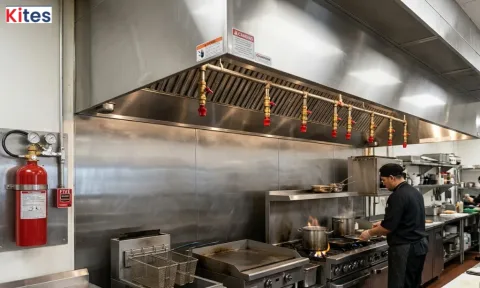
A wet chemical fire suppression system is the current standard for commercial cooking lines, according to Kites' site, and NFPA 17A is the standard for wet chemical extinguishing systems. The agent is engineered for cooking-oil and grease fires: it cools the fuel and reacts with hot oil to form a soap-like layer that helps prevent re-ignition. A kitchen hood fire suppression system works in four moves. Heat detectors sense the fire. Nozzles discharge agent onto the appliances, hood and duct. The gas or electric supply is cut. Staff can trigger the same release from a manual pull station. The same logic applies to a restaurant fire suppression system or a catering unit; size and nozzle layout change, the principle does not.
| Option | What it covers | Fit for the cooking line |
|---|---|---|
| Wet chemical hood system (automatic) | Appliances, hood and ducts | Built for cooking oil; the standard choice |
| Ceiling sprinklers | The room | Do not replace a cooking-line system; water is wrong for burning oil |
| Portable extinguisher | One person's reach | A supplement; works only if someone is close enough |
| Older dry chemical system | Appliances | Kites says wet chemical replaced it as the standard, citing re-ignition risk |
A fuller comparison of agents is in our guide to types of kitchen fire suppression systems. The detection-to-discharge sequence is explained in how a kitchen fire suppression system works.
What Kites Safety Covers, From Survey to Servicing
Kites Advanced Fire & Safety Company is based at 4986 King Khalid - Ar Rabi, Unit No.6, Ad Dammam 32241-8167, and states more than ten years of experience. Its published services are design and engineering, supply and installation, testing and commissioning, inspection, refilling and recharge, preventive maintenance, annual maintenance contracts and 24x7 emergency support. Coverage is listed as Dammam, Khobar, Dhahran, Jubail, Riyadh and Jeddah, and commercial kitchens across the Kingdom. Its industries page lists restaurants, cafes, fast food chains, cloud kitchens, hotels and catering facilities. Kites does not list hood and duct cleaning as a service, so confirm separately who handles it. For a kitchen outside those cities, ask Kites to confirm coverage first. To improve commercial kitchen fire safety, assess, correct the gaps, then keep the system on a service contract so signs 6 and 7 do not return.
Contact Kites Safety for Kitchen Fire Suppression Support on +966 592 066 358 or enquiry@kitessafety.com.
Frequently Asked Questions
What is an automatic fire suppression system in a commercial kitchen?
It is a fixed installation over the cooking line. Heat detectors sense a fire, the system discharges wet chemical agent onto the appliances, hood and ducts without anyone operating it, and the gas or electric supply to the equipment is cut. A manual pull station gives staff a backup release.
What are the warning signs that a kitchen needs a fire suppression system?
Past grease fires, grease inside the hood and ducts, several high-heat appliances on one line, protection that ignores the cooking hazard, a changed layout, lapsed servicing and unconfirmed compliance. One sign is enough to request an assessment.
Is a kitchen hood fire suppression system different from a fire sprinkler system?
Yes. A sprinkler system protects the room with water from ceiling heads. A kitchen hood system targets the appliances, hood and ducts with a wet chemical agent made for cooking-oil fires. Water on burning cooking oil can spread the fire, so sprinklers do not replace the hood system.
Which fire suppression system is commonly used in commercial kitchens?
A wet chemical fire suppression system is the type commonly specified for commercial cooking lines, and NFPA 17A is the standard for wet chemical extinguishing systems. The agent smothers the fire, cools the fuel and forms a soap-like layer over hot oil that helps prevent re-ignition.
Does a restaurant in Saudi Arabia need an automatic kitchen fire suppression system?
Restaurants with fryers, grills or other grease-producing equipment are generally expected to have one as part of Civil Defense approval, under the framework of SBC 801. The exact requirement is confirmed per site, so check yours with the local Civil Defense office or a qualified contractor.
How often does an automatic suppression system need professional inspection?
NFPA 17A calls for a semiannual inspection by a trained, certified person, and Kites describes six-monthly checks as common. The owner should also inspect the system monthly. Confirm the edition and interval that apply with your local authority.
Do I need to update the system when I add or move a fryer or grill?
Usually at least a review. A system is designed around the appliances present at installation, so a new, moved or replaced appliance can sit outside the nozzle coverage. Tell the suppression contractor before the next service, and ask for a coverage review after any change under the hood.
Can a fire extinguisher replace an automatic fire suppression system in a kitchen?
No. A portable extinguisher is manual, so it works only if someone stands close enough to use it. Kitchens still need extinguishers rated for cooking-oil and grease fires within reach of the cooking line, but they supplement the automatic system and do not replace it.
Is the system ready to use again after it discharges?
No. It needs a professional reset and usually a refill of agent before it protects again. Until then, treat the cooking line as unprotected. Call the service contractor straight after any discharge, even if the fire seemed out, so the nozzles, detection line and gas shut-off are checked.
Does an automatic kitchen suppression system also protect the hood and exhaust duct?
Yes, when it is designed to. Kites lists kitchen exhaust hoods, ducts, plenums and filters among the protected areas, alongside the cooking appliances. Protection does not replace cleaning, which the NFPA 96 intervals govern separately.
About the Author • Kites Safety (Kites Advanced Fire & Safety Company) is a commercial kitchen fire suppression specialist in Ad Dammam, Saudi Arabia, offering design, supply and installation, testing, inspection, refilling, maintenance contracts and 24x7 emergency support. About Kites Safety • Reviewed by L K Monu Borkala, a digital marketing strategist with 20+ years of SEO experience and over 650 client campaigns across India and UAE. As a founding member of OneCity Technologies, Bangalore, he oversees content strategy, editorial compliance, and SEO frameworks across education, business services, and digital marketing verticals.
Need help with kitchen fire suppression? Contact Kites