
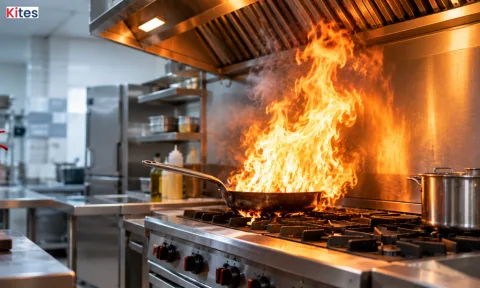
Kitchen Hood & Duct Fires: Causes and Prevention
How Do Kitchen Hood and Duct Fires Start, and How Can They Be Prevented?
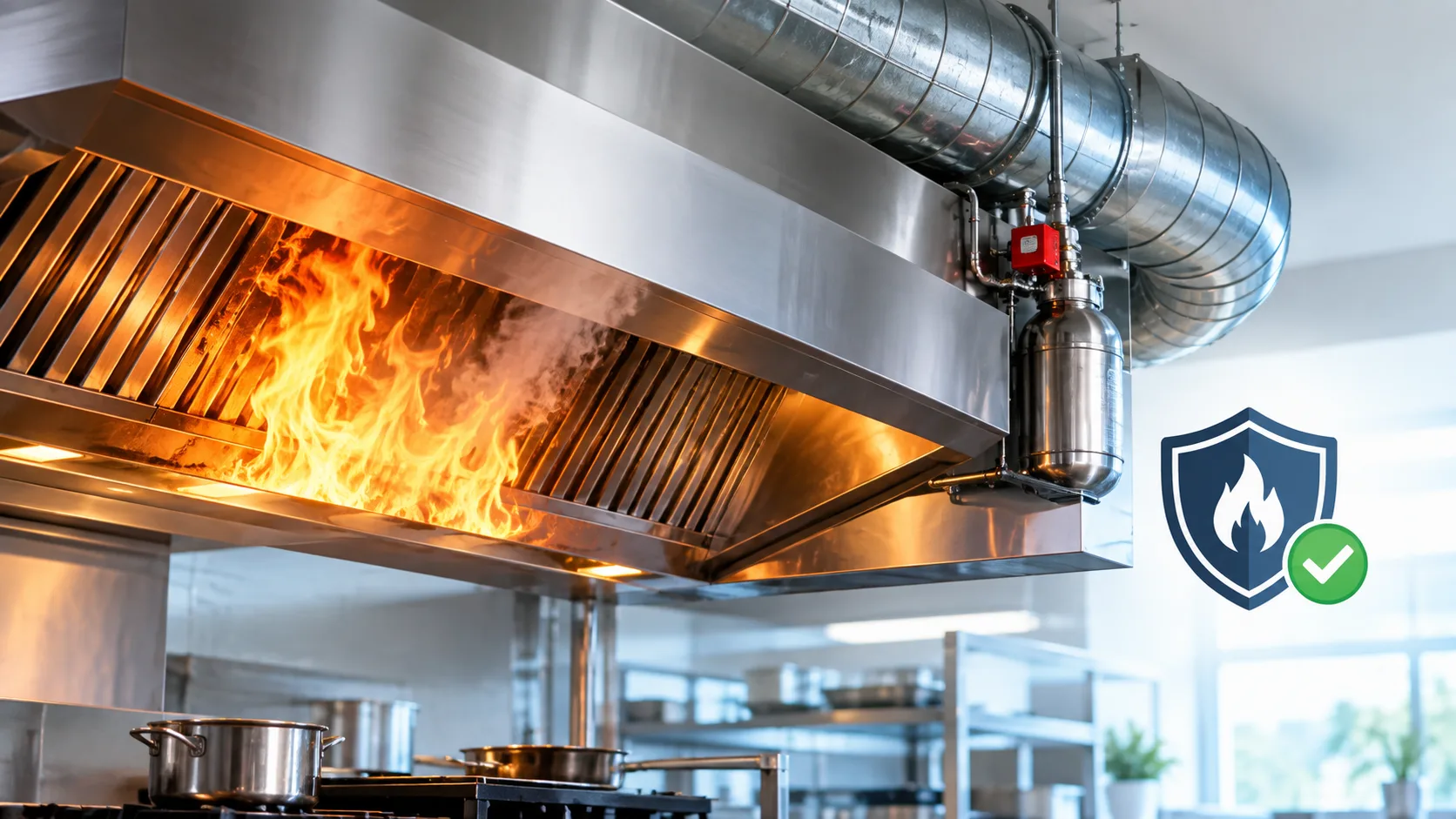
Kitchen hood and duct fires start when grease vapor from cooking settles inside the hood, filters and exhaust ductwork, then ignites from high heat or a spark. Kitchen hood fire prevention relies on regular grease cleaning, a correctly rated suppression system, and scheduled professional inspection.
A commercial kitchen runs its exhaust fan for ten or twelve hours a day, and grease travels with that airflow into the hood, the filters and the duct behind them. Left uncleaned, that grease becomes fuel sitting exactly where heat and sparks already exist. Across Saudi Arabia, Civil Defense inspectors and insurers treat hood and duct fires as one of the most preventable categories of commercial fire loss, precisely because the underlying cause, grease accumulation, is visible and manageable long before it ignites.
Kites Safety works with restaurants, hotel kitchens and catering operations across the Kingdom on exactly this: hood and duct systems built and maintained to Civil Defense and NFPA 96 expectations, not a one-time inspection that quietly lapses.
A hood and duct fire rarely stays contained to the kitchen. Ceiling voids, roof penetrations and shared walls mean the fire and the smoke it produces can reach dining areas, storage rooms or an adjacent tenant's space within minutes, and the resulting closure, repair cost and insurance claim usually outlast the fire itself by months.
Why Are Kitchen Hoods and Exhaust Ducts Vulnerable to Fire?
A kitchen hood and its duct run sit directly above intense heat sources: griddles, fryers, char-broilers and open burners that regularly exceed 200°C at the cooking surface. The hood's job is to pull grease-laden vapor away from the cook before it settles nearby, but the exhaust system itself becomes the collection point for exactly that grease.
Add a constant draft of moving air, which feeds oxygen to any spark or flare-up, and a duct running through a ceiling void or up an exterior wall becomes a route a fire can travel along, largely out of sight, until it reaches the roof or a structural cavity.
Grease filters are designed to trap a large share of airborne grease, not all of it. Even a well-maintained filter passes some vapor through, which is exactly why the duct behind it needs its own cleaning schedule rather than being treated as protected simply because a filter sits in front of it. Static buildup inside a long duct run, and the extraction motor itself running hot after extended service, are two further heat sources most kitchen staff never think about, since neither one is visible from inside the kitchen.
How Do Kitchen Hood and Duct Fires Start?
Most hood and duct fires start the same way: a flare-up or an overheated pan reaches the layer of grease sitting on the filters or inside the duct, and that grease ignites. Filters cleaned on schedule catch a large share of airborne grease before it reaches the duct; filters that are skipped or cleaned late let more of it through.
A wok station or a char-broiler run at high heat for long stretches produces more grease-laden vapor than a standard griddle, so kitchens with heavy-duty cooking equipment need shorter cleaning intervals, not the same schedule used for a lighter menu.
Electrical faults add a second, less obvious pathway. An exhaust fan motor running past its service life, a damaged lighting fixture inside the hood, or wiring that was routed too close to a heat source can all provide the spark even when grease levels are otherwise under control. This is one reason a fire safety inspection checks the extraction system's electrical components alongside the grease itself, rather than treating cleaning and electrical safety as separate concerns.
What Happens When a Fire Reaches the Exhaust Duct?
Once a fire enters the duct itself, it is burning the grease coating the inside walls of the ductwork, not just whatever is on the cooktop. This kind of fire travels along the grease layer in the direction the duct runs, often through ceiling voids or up an exterior riser, and can reach far from where it started before anyone notices smoke.
A standard kitchen fire extinguisher cannot reach inside a sealed duct run. That is why a fire at this stage is treated as a structural fire risk rather than a kitchen incident, and why automatic detection and suppression built into the hood and duct system matters more than any extinguisher kept nearby.
Fire brigades responding to a duct fire often have to open ceiling or roof sections to reach the burning grease directly, since spraying water at the visible flame from below does little once the fire has moved into the duct run. That difficulty, more than the initial flare-up itself, is usually what drives the length of a closure and the size of an insurance claim after a hood or duct fire.
Which Commercial Kitchen Equipment Creates Higher Fire Risks?
Not every piece of kitchen equipment produces the same fire risk:
| Equipment | Main Fire Risk | Why It Matters |
|---|---|---|
| Deep fryers | Oil held near its auto-ignition point | A faulty thermostat or an overfilled basket can ignite the oil directly |
| Solid-fuel grills and ovens | Embers and higher radiant heat | Produces more grease-laden smoke and open flame than gas or electric equipment |
| High-volume wok stations | Sustained very high heat | Often needs dedicated suppression nozzles beyond standard hood coverage |
| Griddles run continuously | Steady grease vapor output | Long service hours mean grease accumulates faster than on lighter-use equipment |
Equipment placed too close to a combustible wall or a low ceiling void raises risk regardless of fuel type, since heat has less room to dissipate before reaching a surface it can ignite.
Menu type matters as much as equipment type in Saudi Arabia's food service market. A shawarma spit running continuously through service hours, a mandi or madfoon setup using open coals, and a high-turnover grill house all sit at the higher end of this risk range, alongside the wok stations and solid-fuel equipment already common in hotel kitchens. A kitchen built around any of these should be assessed and cleaned on that basis, rather than defaulting to a generic restaurant schedule that assumes lighter cooking.
How Can Kitchen Hood and Duct Fires Be Prevented?
Prevention comes down to keeping grease from accumulating faster than it gets removed, and having a suppression system rated for the specific cooking equipment in that kitchen. A solid-fuel or high-volume wok line typically needs hood and duct cleaning far more often than a low-volume cafe kitchen, so the right interval depends on what is actually being cooked and how many hours a day the equipment runs, not a fixed calendar date.
As general guidance, cleaning frequency is usually set by cooking volume and fuel type rather than a single fixed interval:
| Kitchen Type | Typical Cleaning Interval |
|---|---|
| Solid-fuel cooking (charcoal, wood-fired, mandi coals) | Monthly |
| High-volume cooking, 24-hour or near-continuous service | Quarterly |
| Moderate-volume cooking, standard restaurant hours | Every six months |
| Low-volume or seasonal kitchens | Annually |
These intervals reflect general NFPA 96 guidance and what most facilities in Saudi Arabia are assessed against; the exact interval a specific kitchen needs should be confirmed with a qualified inspector rather than assumed from this table alone.
See our kitchen suppression system maintenance checklist for the specific areas a Kites Safety inspection covers on each visit.
Staff awareness matters too: not leaving a fryer unattended, keeping packaging and cloths clear of cooking equipment, and reporting anything unusual, a burning smell, a warm duct panel, a suppression nozzle that looks blocked, before it becomes an incident.
How Does an Automatic Kitchen Fire Suppression System Help?
An automatic kitchen fire suppression system detects heat at the cooking appliance and hood, and discharges a wet chemical agent onto the fryer, griddle or grill surface and into the duct entry point within seconds, well before a fire has time to establish itself in the duct. It also shuts off fuel or power to the cooking line automatically, so the fire is not still being fed while the agent works. We've covered exactly how this sequence works, from detection to discharge, in How Does a Kitchen Fire Suppression System Work?.
Why Professional Installation and Maintenance Matter
A suppression system only works as designed if the nozzles are placed correctly for each specific appliance, the agent is rated for the type of cooking oil in use, and the fuel or power shutoff is actually wired into the system rather than just installed alongside it. We see the same handful of installation mistakes repeatedly across sites that call us in after a failed inspection; they're listed in 5 Common Kitchen Fire Suppression Installation Mistakes to Avoid.
Getting installation right the first time, through a Civil Defense-approved fire suppression contractor, is considerably cheaper than correcting it after a failed inspection, or after a fire.
An unlicensed installation can look complete, cylinder mounted, pipework run, nozzles fitted, while still failing on the details that actually matter during an incident: an agent rated for the wrong type of oil, a shutoff that was never actually connected to the gas line, or nozzle coverage calculated for a different appliance layout than the one on site. None of these show up on a casual walk-through, only on a proper commissioning test and the paperwork that goes with it.
What Should You Check During a Commercial Kitchen Fire Safety Inspection?
A thorough inspection covers more than a quick look at the cylinder gauge:
- Grease buildup inside the hood, filters and accessible duct sections
- Condition and charge status of the suppression system's cylinder
- Nozzle position above each appliance, checked for blockage or misalignment
- Fusible links or heat detectors, checked for damage or a grease coating that could delay activation
- Automatic fuel and power shutoff, tested for an actual response, not just visual inspection
- Manual pull station, checked for clear access and correct signage
- Duct access panels, checked for grease pooling and structural condition
When Should a Kitchen Fire Suppression System Be Serviced?
NFPA 96 and most Civil Defense-aligned facility policies call for a professional service visit at least every six months, regardless of how clean the system looks:
| Situation | Required Action |
|---|---|
| Routine schedule | Professional service at least every 6 months, per NFPA 96 |
| Any discharge, partial or full | Immediate recharge and a full nozzle check before the line reopens |
| Equipment change (new fryer, added burner, different oil) | Reassess nozzle coverage and agent rating for the new setup |
| Failed or borderline inspection | Corrective service before the next Civil Defense re-inspection |
The same applies whenever the kitchen's equipment changes, a new fryer, an added wok burner, or a different oil type, since the system's coverage and agent rating need to match what is actually being cooked underneath it. Full requirements are set out in NFPA 96, the standard most Saudi facilities are inspected against.
Protect Your Commercial Kitchen With Kites Safety
Kites Safety installs, services and inspects kitchen hood and duct fire suppression systems for restaurants, hotels and catering operations across Saudi Arabia, working to Civil Defense and NFPA 96 requirements rather than a generic standard. Whether a kitchen needs a first-time hood suppression system built for Saudi Arabia's commercial kitchens or a scheduled service on an existing installation, matching the system to the kitchen's actual equipment and cooking volume is the starting point for every job we take on.
Talk to Kites Safety About Your Kitchen Fire Safety
Frequently Asked Questions
What causes most kitchen hood and duct fires?
Grease that has accumulated inside the hood, filters or duct is the leading cause. It ignites from a flare-up, overheated oil or a spark, turning a normal cooking fire into one that can travel through the exhaust system.
Can a fire spread through a kitchen exhaust duct?
Yes. A duct fire burns along the grease coating the inside of the ductwork and can travel through ceiling voids or up an exterior riser, often before it is visible from inside the kitchen.
How can grease fires in commercial kitchens be prevented?
Regular hood, filter and duct cleaning on a schedule matched to actual cooking volume, combined with a correctly rated automatic suppression system and routine professional inspection, is the standard approach.
Does a commercial kitchen need an automatic fire suppression system?
Any commercial kitchen using deep fryers, griddles, grills or other appliances that produce grease-laden vapor needs an automatic fire suppression system rated for that equipment, in line with NFPA 96 and Saudi Civil Defense requirements.
How often should a kitchen fire suppression system be inspected?
At minimum every six months, in line with NFPA 96, and immediately after any discharge or a significant change in kitchen equipment.
What should I do after a kitchen fire suppression system activates?
Shut down the affected cooking equipment, evacuate the area if instructed, and have the system professionally recharged with every nozzle checked before returning it to service. A discharged system is not ready to protect the kitchen again until it has been serviced.
Need help with kitchen fire suppression? Contact Kites
0 Comments
Leave a comment
More from the blog
Related articles
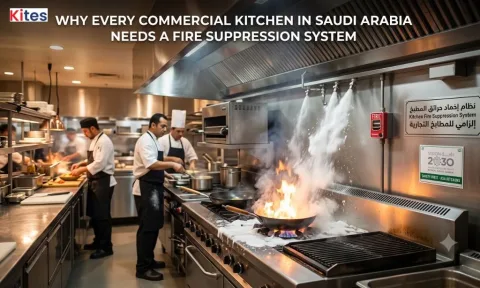
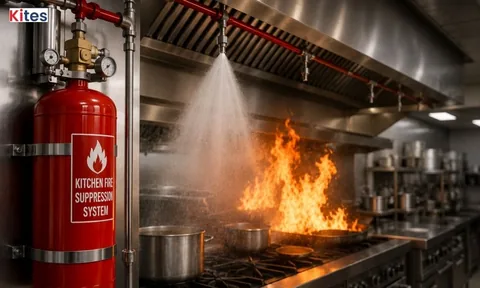
Fire Safety Requirements for Restaurants and Commercial Kitchens in Saudi Arabia
Fire safety requirements for restaurants in Saudi Arabia: suppression, extinguishers, alarms, exits, gas and electrical safety, and inspection, explained.